
What ZKML actually verifies
Zero-Knowledge Machine Learning (ZKML) is the intersection of zero-knowledge proofs (ZKPs) and machine learning algorithms. It allows a prover to demonstrate that a specific machine learning model was executed correctly on specific data, without revealing the model’s weights or the input data itself. This capability transforms AI from a "black box" into a verifiable service.
To understand the distinction, consider a traditional cloud AI service. When you send data to a remote model, you must trust the provider not to tamper with the inference or leak your data. ZKML removes this trust requirement. Instead of trusting the provider, you verify a cryptographic proof attached to the result. If the proof is valid, you know the output came from the exact model specified, running on the exact input provided, without ever seeing the internal parameters.
This verification process involves three core elements: the model architecture, the inference circuit, and the proof. The model is first translated into a constraint system—a set of mathematical rules that define how data flows through the neural network. When the inference runs, the system generates a proof that every step adhered to these rules. This proof is then verified by a third party or on-chain, confirming the computation was performed correctly.
The value proposition is clear: you get the benefits of cloud-scale AI inference without the risks of opaque execution. Enterprises can audit AI decisions for compliance, developers can protect their proprietary models from reverse engineering, and users can verify that their private data was not misused. ZKML shifts the focus from trusting the provider to verifying the result.
Converting models to ZK circuits
Standard machine learning frameworks like PyTorch and TensorFlow are built for floating-point arithmetic and GPU acceleration. Zero-knowledge proof systems, however, operate on finite fields and arithmetic circuits. To verify an AI inference without leaking secrets, you must translate the model’s logic into a format the prover can execute. This translation is the most computationally intensive part of ZKML.
The process follows a strict pipeline: export, quantize, translate, and optimize. Each step introduces specific constraints that shape how the final circuit performs.
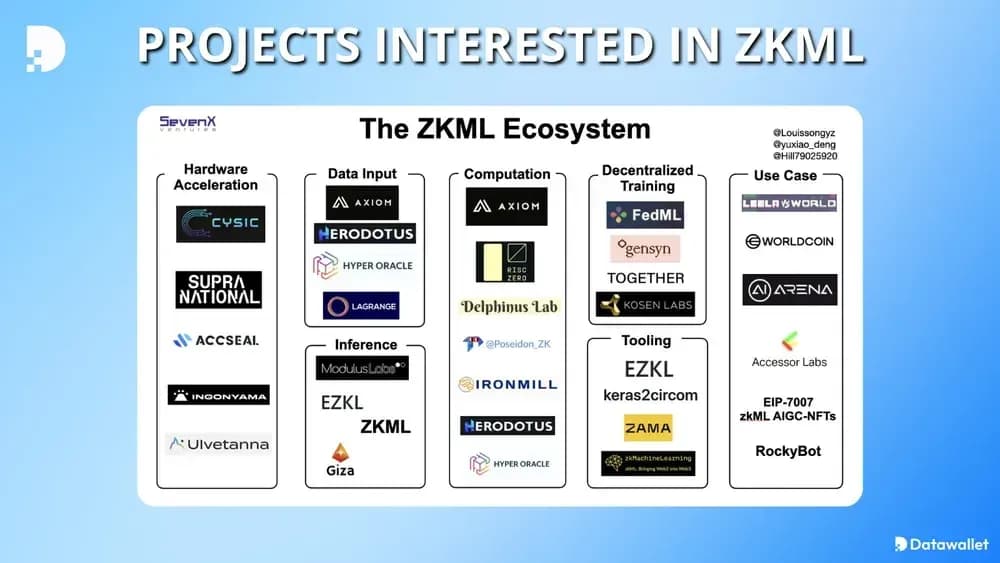
Before you can build a circuit, you need a static representation of the model. Exporting from PyTorch or TensorFlow to ONNX (Open Neural Network Exchange) is the industry standard. ONNX provides a framework-agnostic graph structure that preserves the topology of operations, making it easier to parse later. This step isolates the model architecture from the training framework, ensuring you are working with the exact weights and biases that will be used during inference.

Floating-point operations are expensive in zero-knowledge circuits. Most ZKML frameworks require fixed-point or integer arithmetic to map efficiently to finite fields. Quantization reduces the precision of weights and activations (e.g., from 32-bit float to 8-bit integer). This reduction drastically shrinks the circuit size and speeds up proof generation. While some precision loss is inevitable, careful calibration ensures the verification remains accurate enough for enterprise use cases.
The core challenge is converting high-level operations into Rank-1 Constraint Systems (R1CS). Every matrix multiplication, convolution, or activation function must be decomposed into basic arithmetic gates (addition and multiplication). Frameworks like ddkang/zkml automate this translation, but complex layers like attention mechanisms require manual optimization. The resulting R1CS matrix defines the logic that the prover will execute, effectively turning the neural network into a set of solvable equations.
A raw translation often results in a bloated circuit with redundant constraints. Optimization involves pruning unused variables, merging identical operations, and selecting efficient arithmetic representations. This step is critical for practical deployment. A well-optimized circuit can reduce proof generation time from hours to minutes, making real-time or near-real-time verification feasible for applications like secure AI-as-a-service.
The translation process is not just a technical hurdle; it is a design constraint. When converting models to ZK circuits, you must choose architectures that are inherently more circuit-friendly, such as those with fewer non-linear activations or simpler attention heads. This trade-off between model accuracy and proof efficiency defines the current state of ZKML implementation.
Generating proofs for inference
The runtime process for ZKML inference is less about executing the model and more about proving it. Once the model weights are committed to a cryptographic hash, the prover must generate a mathematical proof that a specific input produced a specific output using those locked weights. This step transforms a standard AI prediction into a verifiable claim, ensuring that the computation was performed exactly as defined without exposing the underlying data or model architecture.
The generation process begins by translating the neural network’s operations into arithmetic circuits. Unlike traditional code, these circuits represent every addition, multiplication, and activation function as a constraint in a finite field. The prover takes the input data and runs it through this circuit, calculating the intermediate values for each neuron and layer. This simulation is computationally intensive, as it requires evaluating the entire network structure step-by-step to ensure every mathematical operation adheres to the predefined constraints.
To optimize this process, systems like ZKML employ specialized compilers that simulate circuit layouts and select the most efficient configuration. By analyzing the cost model of different circuit designs, the system can minimize the number of constraints and reduce the proof generation time. This optimization is critical for practical deployment, as generating proofs for large language models or complex vision networks can otherwise be prohibitively slow. The goal is to balance the size of the circuit with the speed of proof generation, ensuring that verification remains feasible for enterprise-scale applications.
Once the circuit execution is complete, the prover uses a zero-knowledge proof system, such as SNARKs or STARKs, to compress these calculations into a short, verifiable proof. This proof attests that the input-output pair is consistent with the committed model weights, without revealing the weights themselves or the internal computations. The verifier can then check this proof independently, gaining confidence in the AI’s decision without needing to trust the prover or access the sensitive model data.
Verifying proofs on-chain or off-chain
Once the ZKML circuit generates a proof that the model inference was correct, the next critical decision is where to verify it. This choice fundamentally alters the cost structure and trust assumptions of your system. You must weigh the immutability of on-chain verification against the efficiency of off-chain architectures.
On-chain verification
Verifying proofs directly on a blockchain provides the highest level of trust and transparency. Because the verification logic is embedded in smart contracts, anyone can audit the result without relying on a third party. This approach is ideal for high-stakes applications where regulatory compliance or public auditability is mandatory.
However, this comes at a steep price. Gas fees for verifying complex ZKML proofs can be prohibitive, often costing hundreds of dollars per inference depending on the network congestion. Also, the computational complexity of the verification circuit limits the size and type of models you can deploy. You are effectively trading cost for absolute, decentralized assurance.
Off-chain verification
Off-chain verification moves the verification step to a dedicated server or a decentralized network of verifiers. This method drastically reduces latency and cost, making it feasible for high-throughput applications like real-time fraud detection or personalized recommendations. The verifier computes the proof validation and returns a simple success or failure signal.
The trade-off is a shift in trust. You must trust the off-chain verifier not to collude or make errors. To mitigate this, many implementations use decentralized networks where multiple independent nodes must agree on the result. This reduces the risk of single-point failure but requires careful setup and monitoring of the verifier infrastructure to ensure integrity.
Comparison of verification strategies
The following table outlines the primary differences between on-chain and off-chain verification for ZKML systems.
| Feature | On-Chain | Off-Chain |
|---|---|---|
| Cost | High (Gas fees) | Low (Server costs) |
| Trust Model | Decentralized | Centralized or Multi-party |
| Latency | High (Block time) | Low (Milliseconds) |
| Scalability | Limited by gas | Highly scalable |
| Auditability | Public and immutable | Requires trust in verifier |
Choosing a ZKML framework
Selecting the right ZKML framework depends on your model architecture, latency constraints, and deployment environment. The ecosystem is fragmented, with tools optimized for different stages of the inference pipeline. You must match the toolchain to your specific technical requirements rather than chasing the most popular option.
EZKL is designed for high-performance inference on standard hardware. It supports TensorFlow, PyTorch, and ONNX models, making it a strong choice for enterprise applications that require low latency. EZKL generates efficient proof circuits that can be verified quickly, which is critical for real-time decision-making systems. It is particularly effective for linear and convolutional layers common in computer vision tasks.
Polygon Miden offers a virtual machine environment for executing ML models within the ZK-proof system. This approach allows for more complex model structures that might not map cleanly to standard circuit generators. It is suitable for developers who need fine-grained control over the proof generation process and are willing to accept higher computational overhead for flexibility.
Polyhedra Network provides a unified infrastructure for zkML verification. Their framework abstracts much of the complexity, allowing you to verify models across different blockchains and environments. This is ideal for projects that require cross-chain interoperability or need to integrate ZKML into existing decentralized applications without rebuilding the verification layer from scratch.
Checklist for Framework Selection
-
Model Compatibility: Does the framework support your model’s format (ONNX, PyTorch, TensorFlow)?
-
Latency Requirements: Can the proof generation and verification meet your real-time constraints?
-
Hardware Constraints: Is the proof generation efficient on your target hardware (CPU/GPU/VM)?
-
Integration Ease: How difficult is it to integrate the verifier into your existing blockchain or cloud infrastructure?
-
Community & Support: Is there active development, documentation, and community support for troubleshooting?
Common ZKML implementation pitfalls
Zero-knowledge machine learning (ZKML) is moving from theory to production, but the engineering hurdles are substantial. Building a proof for a neural network is not like signing a transaction; it involves translating complex floating-point arithmetic into constrained circuits. When the circuit size exceeds the prover’s memory or the proving time becomes prohibitive, the system fails to scale.
Circuit size limits
Neural networks contain millions of parameters. Converting every matrix multiplication and activation function into R1CS (Rank-1 Constraint System) constraints creates massive circuit sizes. For example, a simple ResNet-50 can require billions of constraints. Current SNARK systems like Groth16 or Plonk struggle with circuits exceeding a few million constraints without specialized optimization. If the circuit is too large, the prover cannot generate the proof within a reasonable timeframe, or the verification cost becomes prohibitive for on-chain validation.
Quantization errors
ZK proofs operate over finite fields, not floating-point numbers. To fit neural network operations into these fields, models must be quantized—converting 32-bit floats to 8-bit integers or fixed-point representations. This process introduces rounding errors. If the quantization precision is too low, the proof might verify as "valid" but produce an incorrect inference result. Engineers must carefully balance precision with circuit complexity, often using techniques like affine quantization to minimize error while keeping constraint counts manageable.
Prover latency
Even with optimized circuits, proving a complex ML inference can take minutes or hours. This latency makes ZKML unsuitable for real-time applications like high-frequency trading or live video analysis. While recursive proofs and parallel proving can mitigate this, they add significant architectural complexity. For most enterprise use cases, the proof generation happens off-chain, but the delay must still be acceptable for the specific business workflow.
Frequently asked questions about ZKML
How much does it cost to verify an AI model?
The cost of a ZKML proof depends heavily on the model's complexity and the underlying ZK-circuit design. Recent systems, such as the ZKML optimizer introduced by Chen et al., simulate circuit layouts to find the most cost-effective configuration for specific models like GPT-2 or vision transformers. While proof generation remains computationally intensive, these optimizations have significantly reduced the overhead compared to earlier, brute-force approaches.
Can ZKML verify proprietary or closed-source AI models?
Yes. ZKML allows a model provider to generate a proof that their inference was executed correctly without revealing the model weights or the input data. This is essential for enterprise use cases where intellectual property is a concern. The verifier only checks the cryptographic proof, ensuring the output matches the model's logic without ever seeing the "black box" internals.
Is ZKML ready for production deployment?
ZKML is moving from theoretical research to practical implementation. Frameworks now support state-of-the-art models, but proof generation times can still be a bottleneck for real-time applications. For high-frequency inference, many teams use ZKML for periodic audits or batch verification rather than per-request validation. As ZK-circuit efficiency improves, real-time verification is becoming increasingly feasible.
Does ZKML work with all machine learning frameworks?
ZKML is not framework-agnostic out of the box. It requires the model to be compiled into a specific arithmetic circuit or constraint system. This means models must be adapted to work within the ZK-proof environment, which often involves simplifying non-differentiable operations or approximating complex activations. Compatibility varies by provider, so checking the supported model architectures is a critical first step.
No comments yet. Be the first to share your thoughts!