

Picture this: decentralized AI where models churn out predictions, and you can verify them on-chain without peeking at the secret sauce. zkML sounds like the holy grail for privacy hawks in Web3, right? But let's rip off the band-aid. When it comes to verifiable inference without training data provenance, zkML hits some brutal walls that could tank trust in decentralized AI faster than a rug pull.
Everyone's hyped on zkML fusing zero-knowledge proofs with machine learning. Provers scream, 'I ran this model correctly!' Verifiers nod without seeing inputs or weights. Sources like Kudelski Security tout verifying ML models sans data exposure. ARPA Network calls it a game-changer for secure, scalable AI. Surveys on arXiv track years of research since 2017. Mitosis University dreams of private data in training. Symbolic Capital pitches decentralized training across nodes. World Network breaks down ZK basics. ScienceDirect covers on-chain verification. DEV Community pushes tamper-proof LLMs on legit data. Cryptowisser loves private AI outputs. Polyhedra eyes model audits. Sounds bulletproof? Not quite.
Why zkML Promises Fall Flat on Training Data Trust
In decentralized AI, models train on sharded data across nodes. Cool for scale, nightmare for proof. Without zkML training data provenance, how do you know the model didn't gobble poisoned datasets or scraped junk? Opacity breeds doubt. Stakeholders demand ethics checks, but zkML hides the data to protect privacy. Result? A trust black hole. Imagine deploying a model for DeFi lending, one bad training batch, and boom, biased decisions cascade. zk proofs shine for inference verification, but they skip the origin story.
This gap explodes in high-stakes apps like fraud detection or medical diagnostics on blockchain. Polyhedra mentions model audits on test sets, but that's post-training. What about the cradle? Recent chatter exposes this as zkML's Achilles heel.
Key zkML Limitations
| Limitation | Description | Impact |
|---|---|---|
| Lack of Training Data Transparency | Ensuring the integrity of AI models in decentralized environments is challenging without access to the original training data. This opacity prevents verification of authorized or ethical datasets. | Trust issues for stakeholders relying on model outputs. |
| Computational Overhead | Generating ZK proofs for complex models (e.g., ResNet-50) incurs significant computational costs. | Proof generation takes ~10 minutes on high-end hardware, making real-time verification impractical. |
| Privacy vs. Verifiability Paradox | On-chain AI verification requires full transparency of proprietary model weights. | Compromises the commercial value of opaque, proprietary weights. |
Computational Overkill Crushing Real-World zkML Dreams
Let's talk hardware hell. Generating ZK proofs for beasts like ResNet-50? Chainscorelabs clocks it at 10 minutes on top-tier rigs. Real-time inference? Forget it. Decentralized AI needs snappy verifiability for trading bots or live predictions, not hourglass waits. Costs skyrocket too, proving complex models drains GPUs like a memecoin pump-and-dump.
Off-chain inference with on-chain proofs helps, per ScienceDirect, but training provenance amps complexity. Scale to billion-parameter LLMs? Proof gen balloons exponentially. High-risk DeFi traders like me need alpha-fast verifies, not this slog. zkML's scalable hype crumbles under compute weight.

Privacy Paradox: Verifiability Eats Proprietary Edge
Here's the kicker: on-chain demands transparency, but AI gold is opaque weights. Chainscorelabs nails it, full verification guts commercial value. zkML guards data privacy in inference, yet training roots demand peeks. Publish weights for proof? Competitors feast. Hide 'em? No trust. This privacy vs. verifiability paradox stalls decentralized AI model verification.
Federated learning spreads pain, but aggregation proofs lag without provenance chains. Big Tech laughs, they hoard data centrally. zkML aims to democratize, but without solving this, it's vaporware for trustless ML. Enter recent fixes, but do they cut it? ZKPROV binds datasets to responses with sub-3-second proofs for 8B params. OTR mixes TEEs and fraud proofs for $0.07/query speed. VerifBFL nails federated proofs in seconds. Promising, yet early. These patch holes, but core zkML limitations linger for full zk proofs training data trust.
ZKPROV steps up with a slick binding of certified datasets, model params, and LLM spits, all proven via ZK without leaks. Arxiv drops show proofs scaling sublinearly, clocking under 3.3 seconds end-to-end for chunky 8-billion-param beasts. That's DeFi-fast enough for my high-risk plays, where I need fraud proofs yesterday. But here's my beef: it assumes certified datasets upfront. Who certifies the certifiers in a wild decentralized jungle? Still, it plugs the verifiable ML inference zk gap better than pure inference proofs.
OTR: Hybrid Hustle or Half-Measure?
Optimistic TEE-Rollups mash TEEs with fraud proofs and random ZK spot-checks. Arxiv numbers scream scalability: 99% throughput matching centralized setups, just $0.07 extra per query. Blockchain inference for gen AI without the full ZK tax? Sign me up for trading bots verifying predictions on-chain. Yet, TEEs drag in that trusted hardware ghost. One side-channel hack, and your decentralized AI model verification crumbles. Stochastic checks mitigate, but it's optimistic by name, fraud-proof by gamble. High tolerance here, but not blind faith.
zkSync Technical Analysis Chart
Analysis by Olivia Garcia | Symbol: BINANCE:ZKUSDT | Interval: 1h | Drawings: 5
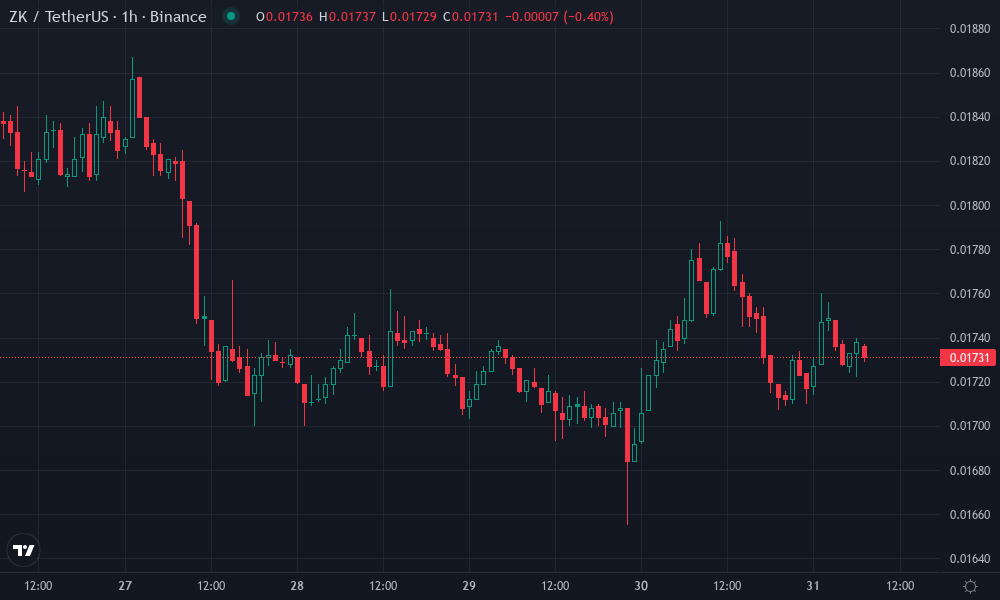
Technical Analysis Summary
Aggressively mark the downtrend from the 0.618 high on 2026-03-28 with a thick red trend_line connecting to the 0.595 low on 2026-03-31. Draw horizontal_lines at key support 0.590 (green, strong) and resistance 0.610 (red, moderate). Add fib_retracement from swing high 0.618 to low 0.590 for potential bounce levels at 0.599 (38.2%) and 0.604 (50%). Rectangle the consolidation zone 2026-03-30 to 31 between 0.595-0.605. Arrow_mark_down on MACD bearish cross. Short position marker at 0.600 breakdown with stop above 0.610 and target 0.580. Callouts on volume spikes confirming dump. Trade fast on this zkML hesitation play.
Risk Assessment: high
Analysis: Volatile crypto day-trade with news overhang on zkML limitations, aggressive setup favors shorts but whipsaw risk on bounces
Olivia Garcia's Recommendation: Short aggressively at 0.600, high tolerance play - trade fast, stack sats privately.
Key Support & Resistance Levels
📈 Support Levels:
- $0.59 - Session low with volume shelf, strong bounce potential but breakdown target strong
- $0.595 - Minor intraday support from recent wicks weak
📉 Resistance Levels:
- $0.61 - Mid-session high rejection zone moderate
- $0.618 - Absolute session high, key overhead supply strong
Trading Zones (high risk tolerance)
🎯 Entry Zones:
- $0.6 - Aggressive short on resistance rejection with MACD confirmation high risk
- $0.599 - Long scalp on fib 38.2% retrace if volume spikes, high risk bounce play high risk
🚪 Exit Zones:
- $0.58 - Profit target below strong support breakdown 💰 profit target
- $0.59 - Trail stop on support breach 🛡️ stop loss
- $0.61 - Short cover if resistance breaks bullish 💰 profit target
Technical Indicators Analysis
📊 Volume Analysis:
Pattern: Increasing on downside with climactic spike at lows
Confirms distribution and seller exhaustion potential
📈 MACD Analysis:
Signal: Bearish crossover with histogram expanding negative
Momentum shift to bears, divergence from price bounce failing
Applied TradingView Drawing Utilities
This chart analysis utilizes the following professional drawing tools:
Disclaimer: This technical analysis by Olivia Garcia is for educational purposes only and should not be considered as financial advice. Trading involves risk, and you should always do your own research before making investment decisions. Past performance does not guarantee future results. The analysis reflects the author's personal methodology and risk tolerance (high).
VerifBFL cranks federated learning with zk-SNARKs and incremental proofs on-chain. zkmodelproofs. com boasts aggregation in 2 seconds, full training under 81. Differential privacy shields against snoops. Perfect for sharded DeFi data where nodes train locally, aggregate trustlessly. I see alpha in this for zkML fraud proofs on lending models. Proves integrity sans central overlords. Downside? Still federated-focused, skips solo training provenance chains.
These frameworks flex muscle, slicing zkML limitations like compute bloat and partial provenance. ZKPROV nails response binding, OTR speeds inference, VerifBFL federates clean. Stack 'em for a provenance tower: certify shards, prove aggregation, verify inference. Boom, full zkML training data provenance pipeline. But decentralized AI ain't there yet. Frameworks demand upfront dataset certs or TEE trust, circling back to opacity roots. Proof gen still hungers hardware; scale to trillion-param monsters? Exponential pain awaits.

Dig deeper, the real gut-punch lands in adversarial wilds. Poisoned data slips certs via subtle flips. Inference proofs check math, not ethics. zkML verifies computation, not intent. Deploy a model claiming clean training; without end-to-end zk proofs training data trust, it's blind faith. Big Tech sidesteps with moats; we need zkML to outpace via crypto rigor.
Flash to my DeFi trenches: I trade fast, prove privately. zkML fraud proofs catch model drifts mid-lend, but sans provenance, one tainted batch nukes alpha. Recent strides scream progress, yet expose the bet: premature for VCs per chainscorelabs, but moonshot for aggressive specs like me. Hybrid paths blend ZK with TEEs short-term, pure ZK long-game.
Decentralized AI thrives when verifiable inference without training data provenance flips from flaw to feature. Frameworks pave, community builds. zkML evolves feral-fast; watch proofs shrink, provenance chain. Trade the dip, prove the peak. Privacy reigns, trust scales. The fusion of crypto and AI just got teeth.

No comments yet. Be the first to share your thoughts!