
What is ZKML?
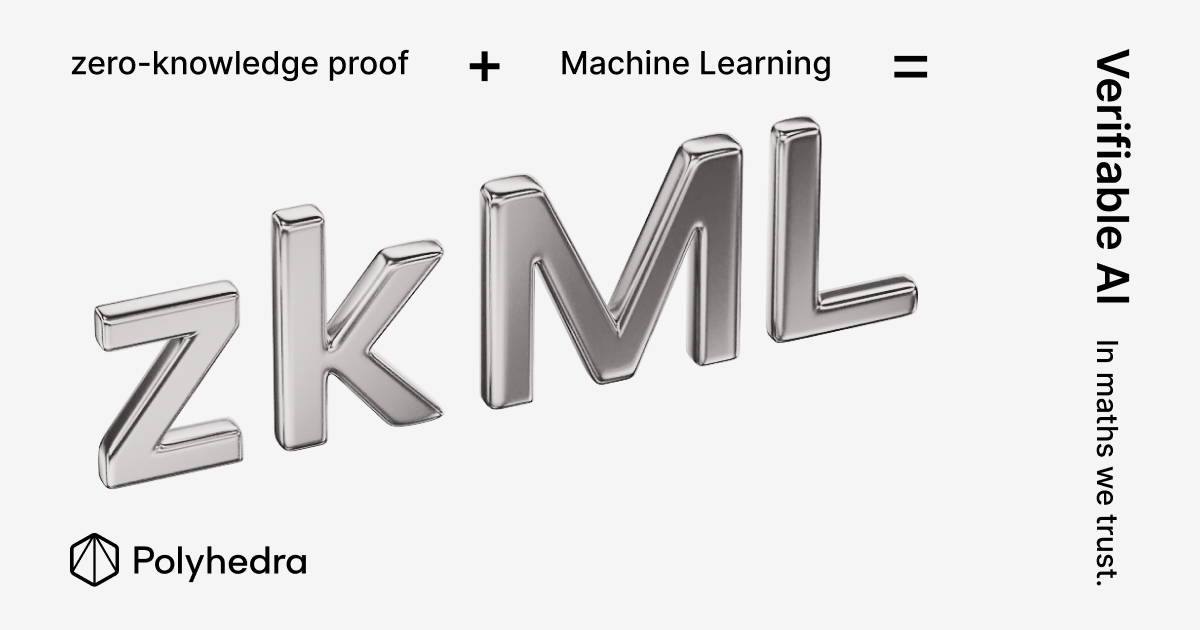
Zero-Knowledge Machine Learning, or ZKML, sits at the intersection of two powerful fields: zero-knowledge proofs (ZKPs) and machine learning. In simple terms, ZKML allows anyone to verify that an AI model produced a specific output without needing to see the underlying data or the proprietary weights of the model itself.
Traditionally, verifying an AI’s decision required trusting the provider. You had to assume they weren’t manipulating results or leaking sensitive information. ZKML changes this dynamic by providing cryptographic proof of correctness. It is the next evolution of AI trust, enabling verification without revelation.
This technology is particularly valuable for enterprise and privacy-sensitive applications. It ensures that sensitive data remains private while still allowing third parties to confirm that the AI followed the correct logic. As noted by Polyhedra Network, ZKML allows anyone to verify that an AI model was executed correctly—without revealing how Polyhedra Network.
Key Takeaways
ZKML combines zero-knowledge proofs with ML inference to verify model outputs without exposing the underlying data or proprietary model weights.
The Privacy and Verification Gap
Traditional machine learning relies on a broken trust model. When you run a model in the cloud, you expose your intellectual property to the provider. When you run it locally, you sacrifice the ability to prove the result was generated correctly. Zero-knowledge machine learning (ZKML) bridges this gap by allowing you to verify AI outputs without exposing the underlying data or model weights.
The Cloud Trust Problem
Running inference on remote servers creates a single point of failure for data privacy. To get results, you must send your input data to the provider, giving them full visibility into your sensitive information. Even if the provider claims not to store your data, you have no cryptographic way to verify they aren't. This lack of transparency forces users to trust the provider's honesty and security practices blindly.
The Local Verification Problem
Running models locally solves the data privacy issue but creates a verification void. You can confirm the code ran on your machine, but you cannot easily prove to a third party that the output came from the specific model you intended to use. Malicious actors could swap models or tamper with inputs without detection. Local inference lacks the mathematical proof needed for external auditability.
ZKML: Verification Without Exposure
ZKML combines zero-knowledge proofs with machine learning to solve both problems. It generates a cryptographic proof that a specific model processed specific data to produce a specific output. This proof can be verified by anyone without revealing the data, the model weights, or the intermediate computations. It shifts the trust from the provider to the mathematics.
How ZKML Proofs Work
ZKML turns machine learning inference into a mathematical puzzle. Instead of running a model on raw data and exposing the results, the system constructs a proof that the computation was performed correctly without revealing the inputs, weights, or intermediate steps.
The process begins by translating the neural network’s operations—matrix multiplications, convolutions, and activation functions—into an arithmetic circuit. Think of this circuit as a set of rigid algebraic equations. Every addition, multiplication, and non-linear activation in the model must be expressed as a constraint within this circuit. If the model uses a ReLU activation, for example, the circuit includes specific constraints that force the output to be either zero or the input value, depending on the sign.
Once the model is represented as a circuit, a prover generates a succinct non-interactive argument of knowledge (SNARK) or a scalable transparent argument of knowledge (STARK). This proof is a tiny cryptographic artifact that attests to the validity of the entire computation. A verifier can then check this proof in milliseconds, regardless of how complex the underlying AI model is.
This approach allows anyone to verify that an AI made a decision based on specific rules and data, without needing to trust the provider or expose sensitive information. The security of ZKML relies on the fact that creating a valid proof for an incorrect computation is computationally infeasible.
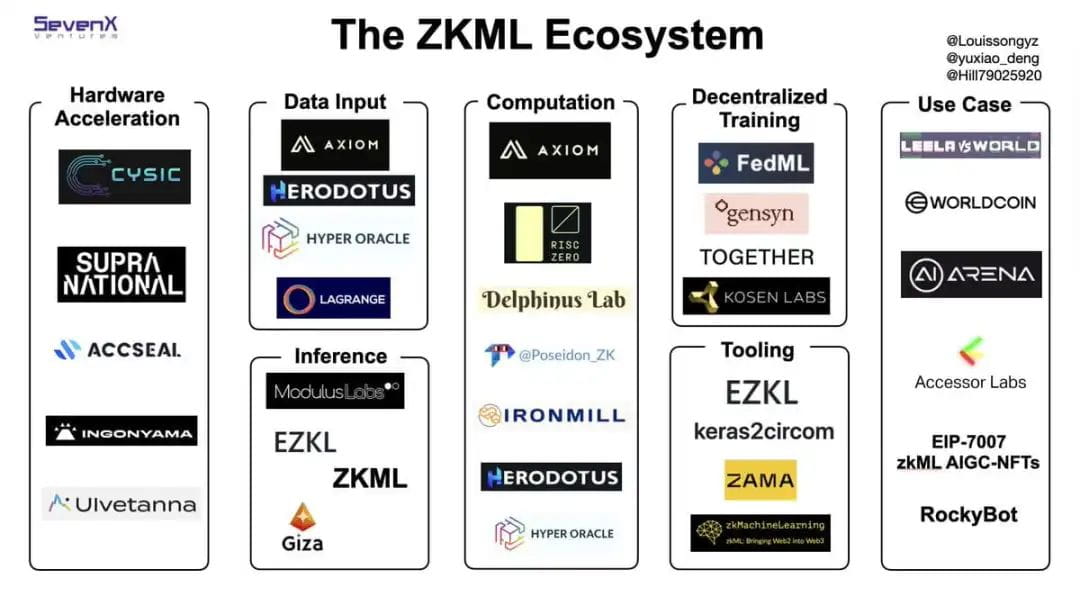
Real-World ZKML Use Cases
Use this section to make the ZKML Explained decision easier to compare in real life, not just on paper. Start with the reader's actual constraint, then separate must-have requirements from details that are merely nice to have. A practical choice should survive normal use, maintenance, timing, and budget. If a recommendation only works in an ideal situation, call that out plainly and give the reader a fallback path.
The simplest way to use this section is to write down the must-have criteria first, then compare each option against those criteria before weighing nice-to-have features.
Challenges in ZKML Adoption
Moving zero-knowledge machine learning (ZKML) from research papers to production environments introduces three significant friction points. While the theoretical promise is strong, the engineering reality currently demands heavy compromises.
The primary bottleneck is computational overhead. Generating a zero-knowledge proof for even a modest neural network requires executing thousands of arithmetic operations per inference. This makes ZKML significantly slower than standard cloud inference, often taking minutes to prove what a GPU verifies in milliseconds. For latency-sensitive applications like real-time fraud detection, this delay is currently prohibitive.
Circuit compilation complexity presents a second hurdle. Unlike traditional software, you cannot simply run a PyTorch model and add a proof layer. The model must be translated into a constraint system (circuit) that the ZK prover understands. This process is manual, error-prone, and requires deep expertise in both machine learning architectures and cryptographic primitives. Recent frameworks like ZKML aim to automate this, but they still struggle with non-linear operations common in modern transformers.
Finally, there is a direct trade-off between proof speed and model size. To keep proof generation time manageable, developers often have to strip down models, reducing their accuracy or capacity. A smaller model proves faster but may not be precise enough for critical decisions. This forces teams to choose between privacy and performance, a choice that rarely exists in traditional ML pipelines.
Frequently asked: what to check next
Zero-Knowledge Machine Learning (ZKML) is an emerging technology that combines zero-knowledge proofs (ZKPs) with machine learning algorithms to verify computations without revealing the underlying data or model weights. It is a field of research and development that has been making waves in cryptography circles recently as a solution for privacy-preserving AI.
What does ZK stand for?
ZK stands for Zero-Knowledge. It refers to a cryptographic method by which one party can prove to another that a statement is true without revealing any information beyond the validity of the statement itself. In the context of AI, this means proving a model's output is correct without exposing the training data or the proprietary algorithm.
Is zero-knowledge proof legit?
Yes, zero-knowledge proofs are mathematically rigorous and widely accepted in computer science. While the concept has been around since the 1980s, recent advancements in zk-SNARKs and zk-STARKs have made them practical for real-world applications. They are not a theoretical gimmick but a robust cryptographic primitive used in blockchain verification and secure computing.
What is ZK used for?
Beyond AI verification, ZK technology is primarily used in blockchain scalability and privacy. It allows blockchains to process transactions off-chain and submit a compact proof to the main chain, reducing congestion. It is also used in identity systems, allowing users to prove age or residency without sharing their full personal documents.
Does XRP use ZKP?
The XRP Ledger does not currently use zero-knowledge proofs as a core consensus mechanism. While XRP focuses on fast settlement and low fees, ZKP integration is more common in privacy-focused coins like Zcash or scalability layers in Ethereum. However, developers are increasingly exploring ZKML for verifying AI models on various chains, including those with XRP's infrastructure.
No comments yet. Be the first to share your thoughts!