
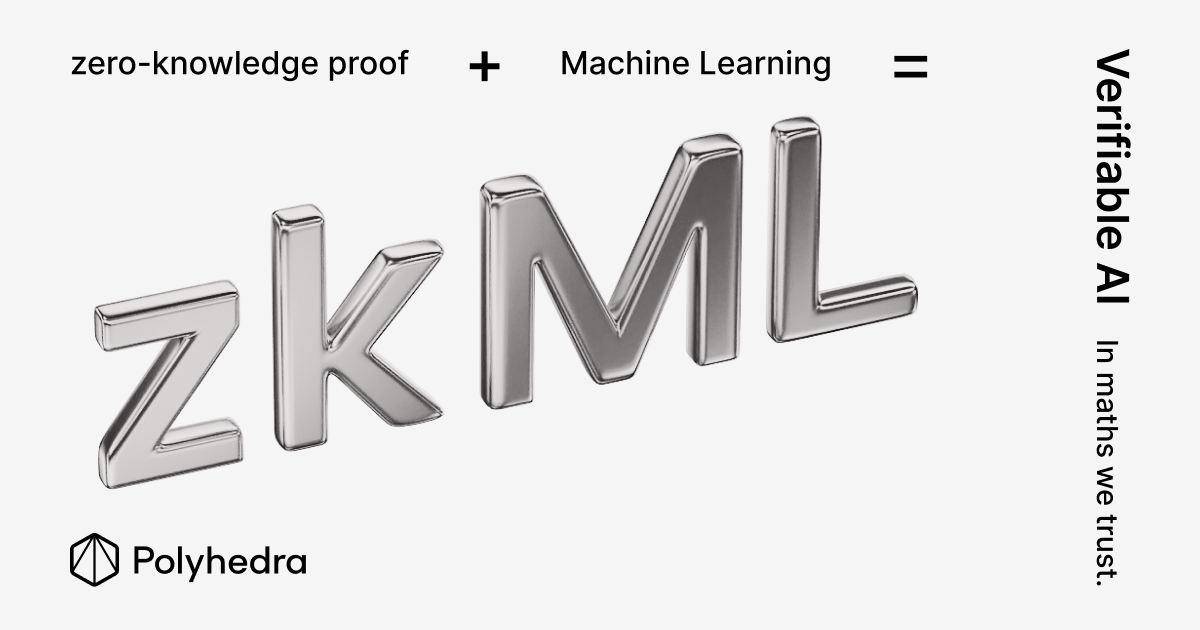
What zero-knowledge machine learning actually is
Zero-knowledge machine learning (ZKML) merges two distinct cryptographic and computational fields: machine learning inference and zero-knowledge proofs (ZKPs). At its core, it is a protocol that allows a party to prove that an AI model executed correctly on specific data without revealing the model weights or the input data itself.
In a standard machine learning workflow, the "prover" runs an algorithm on input data to generate an output. ZKML adds a cryptographic layer where the prover generates a proof that the computation was performed accurately according to the model's logic. A "verifier" can then check this proof mathematically. This ensures the output is genuine without the verifier needing to trust the prover or see the underlying proprietary model.
This mechanism is critical for enterprise and financial applications where data privacy and model intellectual property are paramount. Unlike traditional zero-knowledge proofs which might verify simple statements (like "I know a password"), ZKML verifies complex mathematical operations inherent to neural network inference. By cryptographically binding the output to the execution trace, organizations can share AI-driven insights while maintaining strict confidentiality of the sensitive data and the algorithms that process it.
For more on the foundational cryptographic protocols, see World.org's introduction to ZKML.
Why enterprises need verifiable AI models
Enterprises require verifiable AI models to mitigate risks associated with untrusted inference environments. In sectors like finance and healthcare, the integrity of an AI decision is as critical as the decision itself. Without cryptographic verification, organizations must rely on trust assumptions regarding the hardware, software, or third-party providers hosting the model.
ZKML addresses this by providing mathematical assurance that the model executed as intended. This is distinct from traditional security measures like encryption, which protect data at rest or in transit but do not verify the correctness of the computation performed on that data. By decoupling the computation from the verification, ZKML allows enterprises to deploy models in public or semi-public clouds without exposing proprietary algorithms or sensitive customer data.
How zero-knowledge machine learning verification works
ZKML verification operates by generating a cryptographic proof during model inference that certifies the output was produced by the correct model logic on the given input. This mechanism allows a verifier to confirm the integrity of an AI prediction without accessing the underlying weights, training data, or the input itself. The process effectively decouples the computation from the verification, ensuring that the result is both private and trustworthy.
The workflow follows a distinct sequence of cryptographic steps, transforming a standard machine learning inference into a verifiable zero-knowledge proof.
- Circuit Compilation: The model architecture, including its weights and activation functions, is translated into a constraint system known as a circuit. This compilation step defines the mathematical rules that any valid inference must satisfy, establishing the foundational logic for the subsequent proof generation.
- Input Commitment: The data owner commits to their input data without revealing it. This commitment ensures that the prover is working with the specific data they claim to have, preventing manipulation while maintaining the confidentiality of the underlying information.
- Proof Generation: The prover executes the model logic within the circuit constraints using the secret input and weights. This generates a complex cryptographic proof that demonstrates the computation was performed correctly according to the circuit's rules, without exposing the intermediate values or the final output details.
- Verification: The verifier checks the proof against the public parameters of the circuit. This step is computationally efficient and confirms that the output is a valid result of the specified model logic, providing cryptographic assurance of integrity without requiring access to the private model or data.
This verification process is critical for enterprise applications where data privacy and model integrity are non-negotiable. By relying on cryptographic proofs rather than trust, organizations can deploy AI models in untrusted environments while maintaining strict control over sensitive information.
ZKML vs. Traditional AI Auditing
Traditional auditing methods for machine learning models rely heavily on trust assumptions that are increasingly difficult to maintain. Third-party reviews and open-source code checks offer transparency, but they do not guarantee that a model’s inference results are accurate or untampered. Shifting from trust in process to trust in mathematics, ZKML replaces these fragile assurances with cryptographic certainty.
The core difference lies in what is being verified. Traditional audits typically review the training data and code architecture, assuming that if the inputs and logic are correct, the output must be correct. However, this approach cannot detect if the model was altered after deployment or if the inference engine was compromised. ZKML solves this by generating a cryptographic proof that the specific computation was performed correctly on the specific data, without revealing either the data or the proprietary model weights.
To understand the operational impact, consider the trade-offs between cryptographic verification and conventional auditing methods.
| Feature | Traditional Auditing | ZKML Verification |
|---|---|---|
| Assurance Basis | Trust in code/process | Trust in mathematics |
| Runtime Integrity | Not guaranteed | Cryptographically guaranteed |
| Data Privacy | Requires data access for audit | No data access required |
| Model IP Protection | Limited (code review) | Full (weights hidden) |
While ZKML introduces significant computational overhead for proof generation, it eliminates the single point of failure inherent in traditional auditing. In high-stakes finance and enterprise environments, the cost of a compromised model often outweighs the latency of proof verification. By ensuring that the output is mathematically bound to the input and the algorithm, ZKML provides a level of assurance that code reviews and manual audits simply cannot achieve.
The computational cost of verification
ZKML introduces a fundamental trade-off that currently limits broad enterprise adoption: the heavy computational burden of proof generation. While verification remains efficient, creating the cryptographic proof that a model executed correctly is resource-intensive. This asymmetry means that while a third party can confirm a result in milliseconds, the prover must expend significant processing power.
Current benchmarks indicate that proof generation times for complex models range from seconds to minutes, a stark contrast to the milliseconds required for standard inference. This latency creates a bottleneck for real-time applications, forcing architects to choose between privacy guarantees and operational speed. As noted in recent surveys of ZK-based verifiable machine learning, the overhead is not merely a software inefficiency but a consequence of encoding arithmetic circuits for neural network operations.
Research is actively targeting these bottlenecks through optimized proving systems and hardware acceleration. However, until these optimizations mature, organizations deploying ZKML must account for the latency and infrastructure costs. The technology is viable for high-stakes, batch-processed verification, but it remains unsuitable for low-latency, high-frequency trading or interactive AI services without significant engineering compromises.
No comments yet. Be the first to share your thoughts!