

Defining ZKML for Enterprise Compliance
In the current landscape of enterprise AI, the acronym ZKML carries a dual meaning that often causes confusion. It refers simultaneously to Zero-Knowledge Machine Learning, a cryptographic protocol for verifying AI computations, and a distinct cryptocurrency asset. For organizations focused on compliance, security, and auditability, the technology is the only relevant component. The token has no bearing on the technical capability to prove that a model ran correctly without exposing its underlying weights or data.
Zero-Knowledge Machine Learning (ZKML) is a framework that allows a third party to verify that a machine learning model executed a specific inference task correctly. It does this by generating a Zero-Knowledge Succinct Non-Interactive Argument of Knowledge (ZK-SNARK). This cryptographic proof confirms the integrity of the output without revealing the proprietary algorithm or the sensitive input data used to generate it. As outlined in academic research, this technology enables the verification of complex models, including vision systems and large language models, while maintaining strict data privacy [1].
The primary utility of ZKML in an enterprise context is establishing trust. When an AI system makes a high-stakes decision, such as approving a loan or diagnosing a medical condition, the organization must prove that the decision was not manipulated. ZKML provides a mathematical guarantee that the model executed exactly as intended. This is critical for regulatory compliance, where auditors require evidence of process integrity rather than just final outcomes.
While the ZKML token trades on cryptocurrency exchanges, its price action is unrelated to the adoption of the verification protocol. Enterprise adoption is driven by the need for verifiable AI, not by speculative asset markets. Confusing the two leads to a fundamental misunderstanding of the technology's purpose. The focus for legal and compliance teams must remain on the cryptographic proof system, which offers a new standard for AI accountability.
Note: This analysis focuses exclusively on the cryptographic protocol for AI verification. The cryptocurrency asset is a separate market instrument with no functional role in the ZKML verification process.
Implementing verifiable AI inference workflows
Enterprises integrate ZKML into their ML pipelines to generate cryptographic proofs of AI behavior without exposing proprietary model weights or sensitive training data. This process transforms opaque "black box" decisions into auditable events, ensuring compliance with enterprise trust standards and regulatory requirements.
The workflow follows a structured sequence, moving from model preparation to on-chain or off-chain verification. Each phase ensures that the proof remains compact enough to verify efficiently while maintaining the integrity of the original computation.
The first step involves translating the machine learning model into a format suitable for zero-knowledge proofs, typically a Rank-1 Constraint System (R1CS) or an Arithmetic Circuit. This compilation process defines the mathematical boundaries of the model’s operations, such as matrix multiplications and activation functions. It effectively creates a circuit that the prover will later execute. This stage is critical because the efficiency of the entire proof generation depends on how well the model is optimized for these constraints.
Once the circuit is defined, the prover executes the model using specific input data and internal weights. Instead of revealing the actual data or weights, the prover generates a succinct cryptographic proof—often a ZK-SNARK—that attests to the correct execution of the circuit. This proof demonstrates that the output was derived from a valid inference run without disclosing the underlying inputs or parameters. The prover must ensure that the computational workload is managed efficiently, as proof generation can be resource-intensive.
The final step involves a verifier, which can be a smart contract on a blockchain or a centralized audit system, checking the validity of the proof. The verifier uses a public verification key to confirm that the proof corresponds to a valid execution of the compiled circuit. If the proof is valid, the system accepts the AI’s output as trustworthy. This step ensures that the enterprise can rely on the AI’s decision-making process without needing to trust the provider or expose sensitive intellectual property.
By standardizing this workflow, organizations can deploy AI models with confidence, knowing that every inference is cryptographically verifiable. This approach supports regulatory audits and internal compliance checks, providing a clear, immutable record of AI behavior without compromising data privacy or model secrecy.
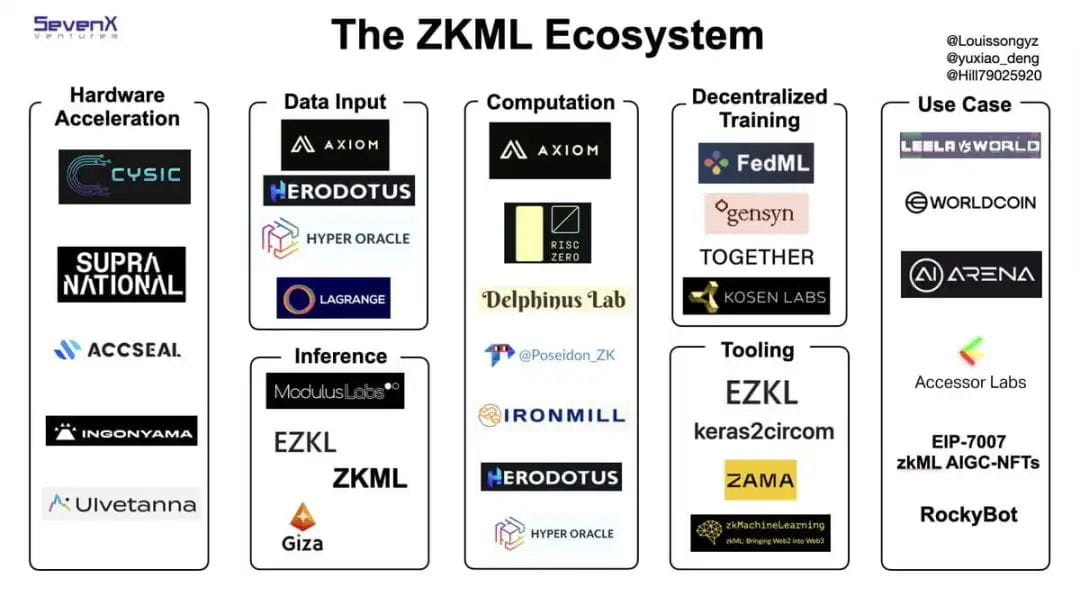
The ZKML Market Landscape and Adoption
The ZKML market is currently defined by a sharp divergence between academic research and commercial infrastructure. While the technology has matured in research circles, the enterprise sector is still navigating the transition from theoretical proofs to deployable compliance tools. According to Tracxn, ZKML remains an unfunded category as of 2024, indicating that capital is currently flowing toward foundational infrastructure rather than consumer-facing applications. This phase is characterized by early-stage development where the primary focus is establishing interoperability standards rather than scaling revenue.
Adoption is currently driven by the need for verifiable AI in high-stakes environments. Organizations are beginning to evaluate ZKML not as a standalone product, but as a critical layer for regulatory compliance. The ecosystem is supported by open-source initiatives like Worldcoin's awesome-zkml repository, which aggregates scientific papers and codebases, signaling that the industry is still in a collaborative, knowledge-sharing phase. This academic foundation is essential for building the trust required for enterprise adoption, as legal and compliance teams require rigorous proof of model integrity.
To understand the current state of the market, it is helpful to compare the leading infrastructure providers. The table below outlines the key differences in supported models and verification speeds, which are the primary metrics for enterprise decision-makers.
| Provider | Supported Models | Verification Speed | Primary Focus |
|---|---|---|---|
| ZKML Foundation | LLMs, CNNs | Medium | Interoperability |
| Worldcoin | Neural Networks | Fast | Privacy-Preserving AI |
| Mina Protocol | Sparse Models | Low | Lightweight Proofs |
| Polygon ID | Identity Models | Variable | Compliance & KYC |
The market is expected to consolidate as the 2026 standards emerge. Early adopters are likely to be in the financial and healthcare sectors, where the cost of non-compliance outweighs the cost of implementation. As the technology matures, we anticipate a shift from generic proof generation to specialized, industry-specific verification protocols.
Navigating regulatory requirements for AI
To make the ZKML decision easier to compare in real life, start with the reader's actual constraint, then separate must-have requirements from details that are merely nice to have. A practical choice should survive normal use, maintenance, timing, and budget. If a recommendation only works in an ideal situation, call that out plainly and give the reader a fallback path.
The simplest way to use this section is to write down the must-have criteria first, then compare each option against those criteria before weighing nice-to-have features.
Technical hurdles and the path to standardization
ZKML currently faces a significant computational overhead. Generating proofs for complex neural networks requires substantial processing power, often making real-time inference impractical for many enterprise workloads. While frameworks like the one detailed by ACM demonstrate that state-of-the-art models can be proven, the cost remains high compared to traditional verification methods [ZKML Optimization System]. This complexity creates a barrier to entry, limiting adoption to high-stakes scenarios where the cost of failure justifies the expense.
By 2026, industry standards are expected to mitigate these friction points through hardware acceleration and optimized proof systems. As ZKML becomes standardized, the focus will shift from experimental proof generation to integrated compliance workflows. Enterprises will likely adopt ZKML not for speculative gains, but as a foundational layer for auditable AI, ensuring that model behavior meets regulatory requirements without exposing proprietary data.
The evolution of ZKML will be driven by the need for trust in automated decision-making. As regulations tighten, the ability to cryptographically verify AI outputs will become as standard as financial auditing. This shift will transform ZKML from a niche cryptographic tool into an essential component of enterprise governance, ensuring accountability in an increasingly automated landscape.
No comments yet. Be the first to share your thoughts!