
The 2026 zkml standard emerges as a critical framework for verifying machine learning integrity without compromising data privacy or proprietary algorithms. This standard addresses the growing regulatory demand for auditable AI systems by leveraging zero-knowledge proofs to ensure computational correctness.
Zero-Knowledge Machine Learning (ZKML) represents a specialized intersection of cryptographic theory and artificial intelligence. It is not merely an application of general cryptography but a distinct protocol layer designed to verify the integrity of machine learning computations. By leveraging zero-knowledge proofs (ZKPs), ZKML allows a prover to demonstrate that a model executed correctly against specific inputs without revealing the underlying algorithm, the training data, or the intermediate states. This distinction is critical for regulatory frameworks that demand transparency in decision-making processes while simultaneously protecting intellectual property and sensitive personal information.
In traditional machine learning, the "black box" nature of models often creates a compliance gap. Regulators and auditors require evidence that a decision—such as a loan denial or a medical diagnosis—was derived from a validated, unbiased model. ZKML addresses this by generating a cryptographic receipt of the computation. As noted by Kudelski Security, this technology enables verifiable machine learning, ensuring that the output is mathematically bound to the input and the model weights, even if those weights are proprietary. This capability shifts the burden of trust from opaque institutional assurances to verifiable cryptographic proof.
The practical utility of ZKML is evident in high-stakes environments where privacy and accuracy must coexist. For instance, in decentralized finance, a lending platform can use ZKML to verify that a borrower's credit score meets a threshold without exposing their full financial history or the proprietary scoring algorithm. This preserves the borrower's privacy while providing the lender with the regulatory assurance needed to comply with fair lending laws. The standard thus serves as a foundational layer for AI trust, enabling compliance with emerging regulations such as the EU AI Act by providing auditable, privacy-preserving evidence of model behavior.
Market Drivers for Verifiable AI
The transition toward ZKML is not merely a technological upgrade but a structural response to the collision between rapid AI adoption and strict regulatory frameworks. As machine learning models increasingly dictate high-stakes outcomes in credit, healthcare, and legal adjudication, the opacity of traditional "black box" algorithms has become a significant legal liability. Compliance with regulations such as the General Data Protection Regulation (GDPR) and the Health Insurance Portability and Accountability Act (HIPAA) requires not only the protection of personal data but also the ability to audit decision-making processes. ZKML addresses this by allowing models to prove their correctness and compliance without exposing the underlying proprietary logic or sensitive input data.
The core utility of ZKML lies in its ability to separate verification from disclosure. In a traditional model, verifying that a computation was performed correctly often requires revealing the inputs and the algorithm itself. ZKML utilizes zero-knowledge proofs (ZKPs) to generate a cryptographic certificate of validity. For instance, in decentralized finance, a lending platform can use ZKML to verify that a borrower’s credit score meets a specific threshold without revealing the borrower’s financial history or the proprietary scoring model used. This preserves the borrower's privacy while satisfying the lender's need for auditability.
This shift is particularly critical in sectors where data sovereignty is paramount. Academic research and industry analyses indicate that ZKML provides a solution to the privacy concerns inherent in traditional machine learning by enabling verification on-chain or in distributed environments without compromising data integrity. As regulatory scrutiny intensifies, the market is increasingly valuing verifiable AI not for its speculative potential, but for its capacity to provide legally defensible, privacy-preserving computational guarantees.
Technical architecture and proof systems
ZKML relies on the mathematical principle that a prover can demonstrate the correctness of a computation without revealing the inputs or the internal logic used to reach the result. In the context of machine learning, this means verifying that an AI model executed its inference task accurately while keeping the proprietary weights and sensitive user data confidential. The architecture functions like a sealed legal ledger: the outcome is visible and verifiable, but the underlying calculation remains hidden until a cryptographic proof is generated and validated by the network.
The core of this system involves translating machine learning operations into arithmetic circuits that can be processed by ZK-SNARKs (Succinct Non-Interactive Arguments of Knowledge). This translation is non-trivial because standard neural networks rely on floating-point arithmetic, which is inefficient and complex to encode in zero-knowledge proofs. Frameworks such as ddkang/zkml address this by introducing optimization layers that simulate the circuit layout process. These systems use cost models to minimize the number of constraints required to represent complex operations, such as matrix multiplications and activation functions, thereby reducing the computational overhead for both proof generation and verification.
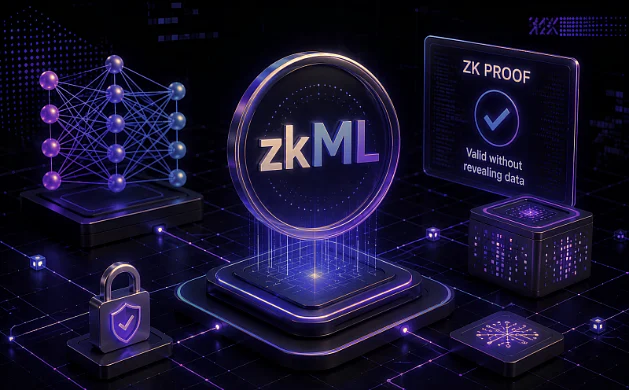
The workflow typically follows a structured pipeline. First, the machine learning model is compiled into a specific circuit format compatible with the chosen SNARK library. Next, the system generates a proof that attests to the correct execution of the model on specific inputs. Finally, a verifier on the blockchain or network checks this proof against the public parameters, confirming the output's validity without re-running the entire model. This process ensures that high-stakes decisions, such as automated loan approvals or medical diagnoses, can be trusted without exposing the underlying proprietary algorithms or private patient data.
For regulatory compliance, the ability to audit these proofs is critical. While the data remains private, the proof itself serves as an immutable record of the model's behavior. This allows auditors to verify that the model adheres to specific constraints or fairness criteria without needing access to the black-box internals. As the technology matures, frameworks like EZKL are further refining this process, making it feasible to deploy ZKML in production environments where performance and privacy are equally prioritized.
Enterprise Use Cases and Adoption
ZKML is transitioning from theoretical cryptography to practical enterprise deployment. The technology addresses a critical friction point in regulated industries: the need to verify AI model integrity without exposing proprietary algorithms or sensitive user data. By generating cryptographic proofs of model execution, organizations can maintain compliance with data privacy laws while enabling interoperable AI systems.
Decentralized Finance and Credit Scoring
In decentralized finance (DeFi), ZKML enables private credit assessment. Traditional lending requires users to disclose full financial histories, creating privacy risks and data silos. ZKML allows a protocol to verify that a borrower’s credit score meets a specific threshold without revealing the underlying data or the proprietary scoring model used. This approach, demonstrated by frameworks like ddkang/zkml, ensures that financial risk assessments remain verifiable yet confidential.
Private Healthcare Analytics
Healthcare providers face strict regulatory constraints, such as HIPAA, which prohibit the sharing of patient data across institutions. ZKML allows hospitals to collaboratively train diagnostic models or verify AI-driven diagnoses without transmitting raw patient records. The system generates a proof that the AI operated correctly on the data, ensuring clinical accuracy and regulatory compliance while keeping patient information isolated within the originating institution.
Infrastructure Comparison
The following comparison highlights the operational trade-offs between traditional transparent ML inference and ZKML-based verification. While ZKML introduces computational overhead, it provides the legal assurance necessary for high-stakes enterprise applications.
| Feature | Traditional ML | ZKML Inference |
|---|---|---|
| Privacy | Low (data exposed) | High (data hidden) |
| Verifiability | Low (black box) | High (cryptographic proof) |
| Computational Cost | Low | High |
| Regulatory Compliance | Complex | Streamlined |
Token economics and market data
The valuation of the ZKML token is currently driven by its role in facilitating verifiable AI computations rather than speculative asset appreciation. As a utility token, its primary function is to cover the gas costs associated with generating and verifying zero-knowledge proofs on-chain. This utility-first model distinguishes it from pure governance tokens, aligning its economic incentives with the actual computational workload of the network.
Market data indicates that the token trades primarily on decentralized exchanges, with Uniswap V2 (Ethereum) serving as the most active trading venue. Recent data shows a trading volume of approximately $523.86 over a 24-hour period, reflecting early-stage adoption among institutional and compliance-focused participants who prioritize privacy-preserving machine learning over retail speculation.
For a deeper technical analysis of price action and volume trends, the following chart provides real-time market data for ZKML/USD. This data is essential for assessing liquidity depth and volatility, which are critical factors for regulatory bodies evaluating the stability of crypto-asset integrations in financial services.
Frequently Asked Questions About ZKML
The intersection of zero-knowledge cryptography and machine learning introduces complex technical and regulatory considerations. The following questions address core definitions, practical applications, and market accessibility for zkML.
No comments yet. Be the first to share your thoughts!