
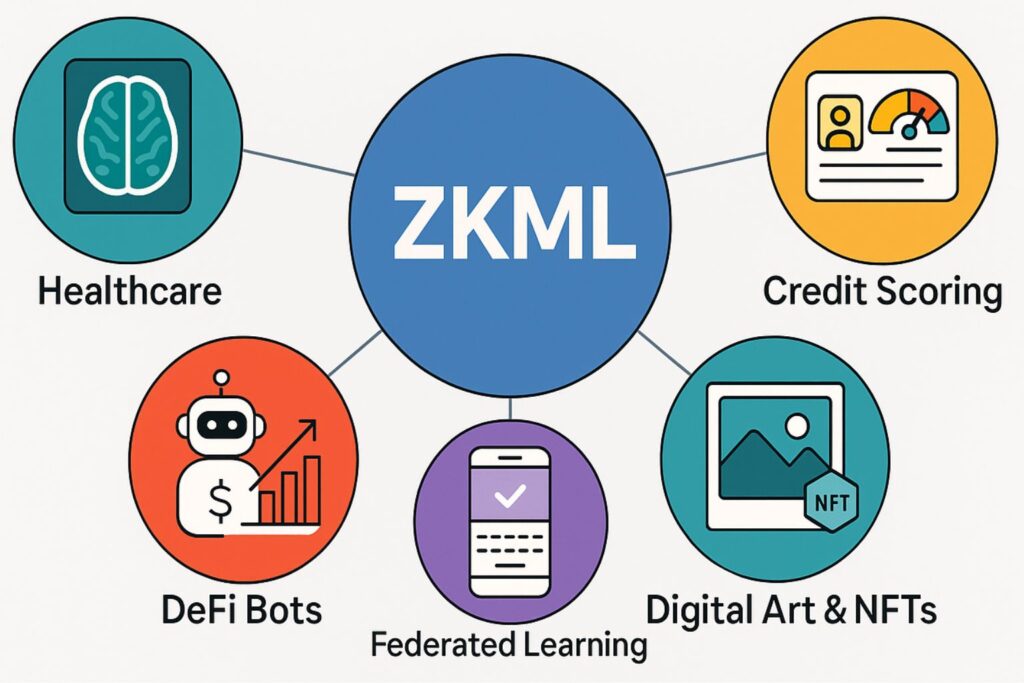
Defining the verifiable AI market
Zero-knowledge machine learning (zkML) has emerged as a distinct segment within the broader cryptographic and artificial intelligence sectors. It represents the convergence of two previously separate disciplines: the privacy-preserving guarantees of zero-knowledge proofs (ZKP) and the computational power of machine learning models. Unlike traditional AI systems, which operate as opaque "black boxes," zkML enables the verification of model execution without exposing the underlying data or proprietary algorithms.
At its core, zkML allows a verifier to confirm that an AI model was executed correctly on specific input data. This is achieved by generating a cryptographic proof alongside the model's output. As defined by Polyhedra Network, this technology ensures that the computation performed matches the expected logic, providing a mathematical guarantee of integrity. This capability is critical for enterprise risk management, where the provenance and accuracy of AI-driven decisions are subject to strict regulatory and compliance scrutiny.
The value proposition for enterprises lies in the ability to audit AI behavior without compromising intellectual property or user privacy. Institutions can now verify transactions or model outputs on blockchain protocols without disclosing sensitive details. This shift transforms AI from a trust-based service to a verifiable utility, addressing the primary barrier to widespread adoption in high-stakes industries such as finance and healthcare.
To contextualize the market's current trajectory, the following widget tracks the performance of a leading asset associated with the zkML ecosystem, reflecting investor sentiment and market liquidity in this nascent sector.
Inference Costs and Proof Generation
The commercial viability of verifiable AI hinges on a fundamental trade-off: the computational expense of generating zero-knowledge proofs against the latency required for inference. For enterprise adoption, this is not merely a technical hurdle but a cost structure challenge. Generating a ZK-SNARK proof for a machine learning model is significantly more expensive than running the inference itself, creating a bottleneck for high-frequency or large-scale applications.
Academic frameworks are actively addressing this inefficiency. The ZKML system, introduced in recent EuroSys research, optimizes the circuit layout process by simulating configurations to determine the most cost-effective structure. By treating the proof generation as an optimization problem rather than a static computation, these systems reduce the overhead required to verify complex models, including vision networks and distilled language models. This optimization is critical for lowering the marginal cost of verification, making it feasible for businesses to audit AI decisions in real-time.
The financial implication is clear: as proof generation costs decrease, the barrier to entry for deploying auditable AI in regulated industries drops. However, until these optimizations become widespread, the cost of verifiable inference remains a premium service. Enterprises must weigh the value of cryptographic assurance against the added computational load, particularly when scaling across thousands of predictions.
The chart above illustrates the market volatility surrounding ZKML-related assets, reflecting the speculative nature of the sector as it matures. While technical milestones are being met, the market price often decouples from the underlying technological progress, driven by broader crypto sentiment rather than specific adoption metrics. Investors should monitor the technical benchmarks closely, as sustained enterprise adoption will eventually align market valuation with the tangible utility of verifiable AI.
Enterprise adoption drivers and risks
Enterprises are moving beyond theoretical interest in zero-knowledge machine learning (zkML) to address specific regulatory and intellectual property constraints. The primary driver is the ability to execute verifiable AI inference without exposing proprietary model weights or sensitive user data. As defined by the Privacy & Security Engineering (PSE) team at the Protocol Labs Foundation, zkML combines zero-knowledge proofs with machine learning to resolve privacy concerns inherent in traditional model deployment [7]. This allows institutions to prove that an AI model executed correctly on specific data without revealing the underlying computations or the data itself, a critical distinction for financial and healthcare sectors.
The value proposition centers on verifiable AI. In high-stakes environments, a standard API response is insufficient; regulators and partners require cryptographic proof of integrity. This shifts the trust model from "trusting the provider" to "verifying the computation." For instance, the XRP Ledger’s integration with Boundless demonstrates how institutions can now verify transactions without revealing amounts, senders, or receivers, illustrating the broader applicability of zero-knowledge proof technologies in securing Web3 infrastructure [3]. Similarly, NTT Data notes that zero-knowledge proofs bring "trustworthiness to the privacy of Web3," positioning them as essential for secure future societies [4].
However, implementation carries significant operational risks. The cryptographic overhead required to generate these proofs introduces latency that can be prohibitive for real-time applications. Generating a proof for a complex neural network is computationally intensive, often requiring specialized hardware or optimized circuits (such as PLONK or Groth16 adaptations) to meet enterprise service level agreements. This complexity creates a barrier to entry, limiting early adopters to use cases where verification is asynchronous or where the cost of a breach outweighs the cost of verification latency.
Note: zkML is not simple data anonymization. It is a cryptographic protocol where the party computing the output generates a proof that the computation was performed correctly on the input, preserving both data privacy and model integrity [1].
The decision to adopt zkML is ultimately a risk management calculation. Organizations must weigh the high cost of implementation and potential latency against the existential risk of IP theft or regulatory non-compliance. For firms handling sensitive financial or health data, the ability to provide cryptographic assurance of compliance is becoming a competitive necessity rather than a technical novelty.
ZKML Platform Landscape
The infrastructure for verifiable AI is fragmenting into specialized protocols, each targeting different layers of the machine learning stack. For enterprise adoption, the choice of platform hinges on the trade-off between proof generation latency and computational overhead.
The following comparison outlines the current maturity of major zkML frameworks. These providers differ primarily in their supported model architectures and the efficiency of their zero-knowledge proof systems.
| Provider | Proof Mechanism | Primary Models | Maturity |
|---|---|---|---|
| Risc Zero | zkVM | General-purpose ML | Production |
| Polygon zkEVM | zkRollup | Smart Contract AI | Mainnet |
| Myria | ZK-Circuit | LLM Inference | Beta |
| Polyhedra Network | zkML SDK | Neural Networks | Testnet |
Investors should note that "production" status often implies limited throughput for complex deep learning models. The industry is currently shifting from proving simple linear regressions to verifying transformer-based architectures, a transition that significantly impacts cost-per-verification.
No comments yet. Be the first to share your thoughts!