
What is ZKML?
Zero-knowledge machine learning (ZKML) sits at the intersection of cryptography and artificial intelligence. It is a protocol that allows a party to prove that an AI model executed correctly on specific data without revealing the model's internal weights or the input data itself. This capability addresses a fundamental privacy gap in traditional machine learning, where verifying a result often requires trusting the provider with sensitive information.
The core mechanism involves generating a zero-knowledge proof (ZKP) alongside the model's output. As defined by the Privacy Scaling Explorations (PSE) initiative, ZKML combines the computational power of machine learning with the cryptographic guarantees of ZKPs. The prover—typically the entity running the model—creates a succinct proof that the computation was performed accurately according to the model's logic. A verifier can then check this proof to confirm the result is valid, without ever seeing the underlying computation or data.
This approach transforms how we handle sensitive AI tasks. Consider a decentralized lending platform evaluating a borrower's creditworthiness. Traditionally, the borrower must share their entire financial history with the lender's proprietary model. With ZKML, the system generates a proof verifying that the borrower's credit score exceeds the required threshold. The lender accepts the proof as evidence of eligibility without ever accessing the borrower's raw financial data or the specific algorithm used to calculate the score.
How ZKML Proofs Are Generated
Generating a zero-knowledge proof for a machine learning model is not a single action but a three-part pipeline. The process transforms a standard neural network into a mathematical circuit, creates a cryptographic witness, and finally verifies that witness against the original model logic. This workflow allows systems to prove an AI made a correct decision without exposing the model weights or the private data used to make it.
The first step is translating the machine learning model into a format that cryptographic provers can understand. Neural networks are built on floating-point math, but zero-knowledge circuits operate on finite fields. Frameworks like ZKML convert the model's layers—linear algebra operations, activations, and pooling—into arithmetic circuits. This compilation ensures every mathematical step the AI takes is represented as a set of constraints that can be mathematically verified.
With the circuit defined, the prover takes the private inputs (such as a user's financial data) and the model's public weights. It runs the computation through the arithmetic circuit and generates a compact cryptographic proof. This proof acts as a mathematical receipt, demonstrating that the computation was executed correctly according to the circuit's rules. Modern systems can prove models at fixed accuracy significantly faster than earlier iterations, reducing the computational burden.
The final step is verification. A verifier—whether a smart contract on a blockchain or a local server—checks the proof against the public parameters of the circuit. If the proof is valid, the verifier accepts the output as authentic without ever seeing the underlying data or the model's internal logic. This allows decentralized applications to trust AI outputs, such as a credit score approval, while maintaining strict data privacy for the user.
This pipeline transforms abstract cryptographic theory into a practical tool for privacy-preserving AI. By separating the computation from the verification, ZKML enables trustless interactions where the integrity of the AI is guaranteed without compromising the confidentiality of the inputs or the proprietary nature of the model itself.
Key ZKML Frameworks and Tools
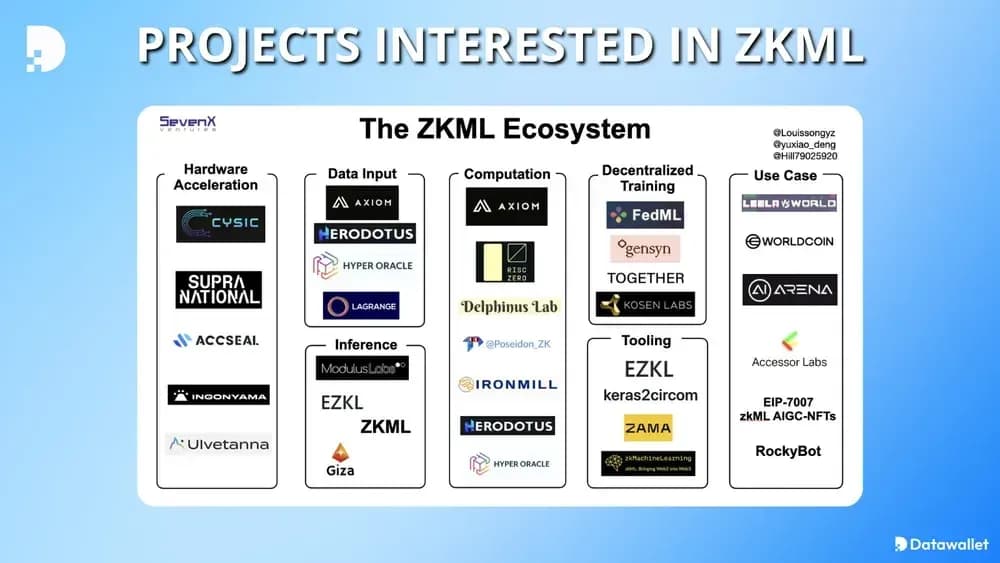
The abstract promise of zero-knowledge machine learning becomes practical through a growing ecosystem of open-source frameworks. These tools bridge the gap between complex cryptographic proofs and standard machine learning models, allowing developers to generate verifiable evidence of model execution without exposing the underlying data or weights.
The most prominent entry point for many developers is ddkang/zkml, a framework designed to construct proofs of ML model execution in ZK-SNARKs. It provides a structured way to compile standard models into a format that can be efficiently proven on-chain. By handling the heavy lifting of circuit generation, it reduces the barrier to entry for teams wanting to integrate privacy-preserving AI into their pipelines.
For a broader view of the landscape, Worldcoin’s awesome-zkml repository serves as a comprehensive index of projects, papers, and applications. It highlights how different organizations are tackling the computational overhead of ZK proofs, from optimized arithmetic circuits to hybrid proving systems. This collective effort is accelerating the maturation of the field beyond theoretical research.
The developer experience is critical for adoption. Below is a conceptual look at how a model might be compiled and proven using these tools, demonstrating the shift from raw model data to a cryptographic assertion.
These frameworks are not just academic exercises; they are enabling real-world use cases like decentralized credit scoring. In such scenarios, a borrower can prove their credit score meets a lender’s threshold without revealing their full financial history, preserving privacy while maintaining trust.
Real-world applications in credit scoring and identity
ZKML moves beyond theoretical cryptography by solving specific privacy bottlenecks in high-stakes sectors. Two areas demonstrate its immediate utility: decentralized credit scoring and verifiable digital identity. In both cases, the goal is to prove a fact without exposing the underlying sensitive data.
Verifying creditworthiness without financial exposure
Traditional credit checks require lenders to access full financial histories, creating significant privacy risks. ZKML allows a borrower to generate a proof that their credit score meets a lending threshold without revealing their income, transaction history, or the proprietary model used to calculate the score.
This approach enables decentralized lending platforms to assess risk accurately while keeping financial data private. The borrower retains control over their information, and the lender receives a cryptographic guarantee that the decision was based on valid, unaltered data.
Decentralized identity with selective disclosure
Digital identity systems often force users to choose between total anonymity and total exposure. ZKML introduces selective disclosure, allowing individuals to prove specific attributes—such as age, residency, or professional certification—without revealing their entire identity.
For example, a user can prove they are over 18 to access a service without sharing their birthdate or government ID number. This reduces the attack surface for identity theft and aligns with privacy-first design principles, making it ideal for compliant KYC (Know Your Customer) processes in Web3.
The zKML token market and infrastructure
The zKML token (ZKML) trades as a utility asset within the growing ecosystem of zero-knowledge machine learning. It serves as the governance and staking mechanism for the underlying protocol, distinguishing itself from general-purpose infrastructure tokens by its specific focus on AI verification. Current market data indicates a price of approximately $0.014, with daily trading volumes reflecting steady, albeit niche, interest from developers and investors tracking privacy-preserving AI.
To understand the financial mechanics, it helps to compare ZKML against broader crypto infrastructure tokens that do not specialize in ML verification. The table below highlights the structural differences in their value propositions and market positioning.
| Feature | zKML Token | General Infra Token | AI Compute Token |
|---|---|---|---|
| Primary Use Case | Verify ML model execution | Network security/governance | GPU rental and compute |
| Privacy Layer | Native ZK proofs | None or optional | Data isolation only |
| Market Maturity | Early-stage niche | Established | Growing rapidly |
| Data Relevance | High (specialized) | Low (broad) | Medium (compute-heavy) |
The live price widget below provides real-time market cap and trading volume data for ZKML, allowing you to track its performance against the broader crypto market.
No comments yet. Be the first to share your thoughts!