

In the evolving landscape of decentralized finance and Web3, zero-knowledge machine learning (zkML) stands as a transformative force, enabling on-chain ML inference without sacrificing privacy or verifiability. Imagine deploying a TensorFlow-trained neural network directly onto Ethereum Layer 2 (L2) networks, where proofs attest to correct execution on private data. EZKL makes this vision tangible, converting complex models into zk-SNARK circuits that Ethereum validators can check in milliseconds. This isn't just technical wizardry; it's the foundation for trustless AI oracles and autonomous agents that redefine macro trends in crypto commodities.
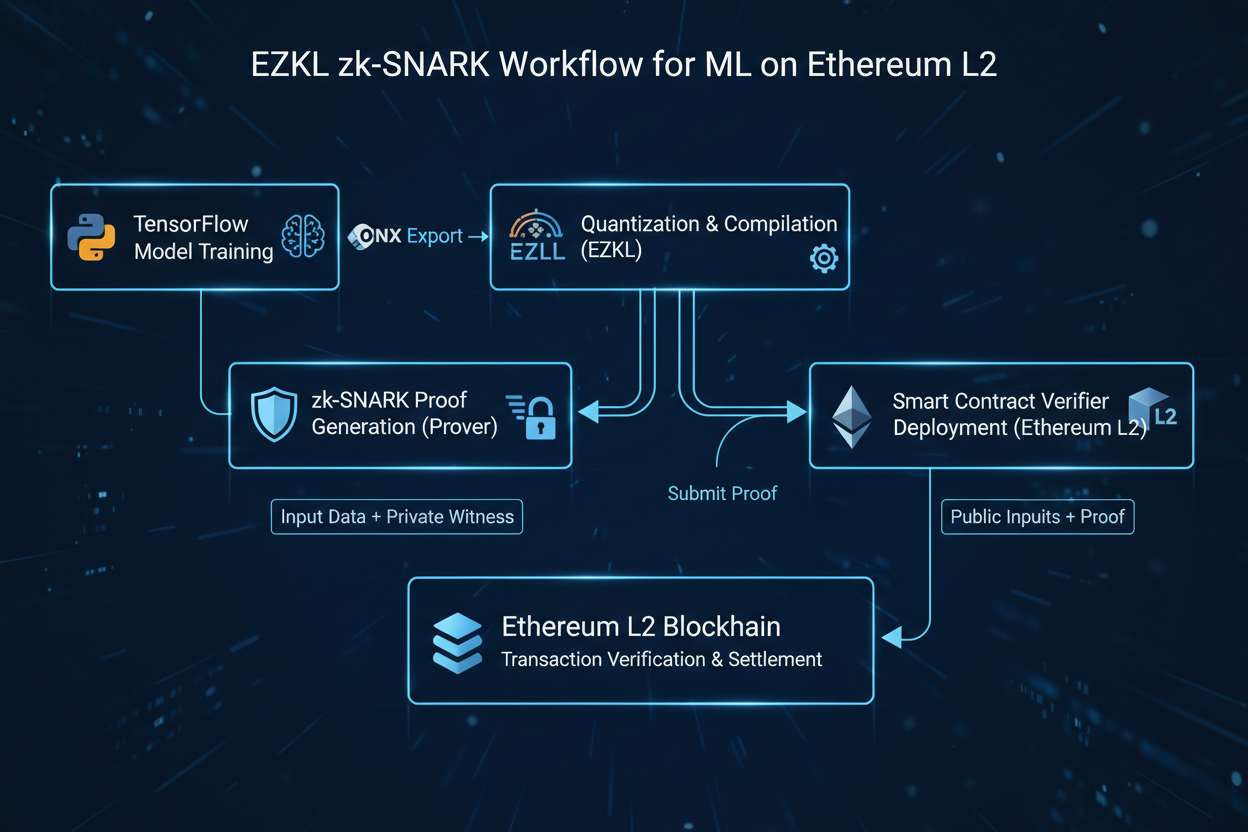
As a macro analyst with eyes on long-term cycles, I see zkML as the hybrid unlock for epic bull runs. Traditional ML models black-box private computations, breeding distrust in high-stakes DeFi decisions. EZKL flips the script: prove that your model outputted a specific prediction on hidden inputs, all verifiable on-chain. Recent optimizations have slashed proof sizes below 200KB, slashing L2 deployment costs and accelerating adoption. Ethereum L2s like Optimism or Arbitrum now host these proofs natively, positioning zkML as the verifiable backbone for the next AI-driven crypto supercycle.
Why EZKL Excels in zkML On-Chain Inference
EZKL, from Zkonduit, emerges as the premier engine for TensorFlow zk proofs. Unlike bespoke circuits that demand weeks of custom engineering, EZKL automates the pipeline from mainstream frameworks to production-ready zk-SNARKs. Its command-line simplicity belies sophisticated backend optimizations: it parses ONNX graphs, applies logarithmic scaling for fixed-point arithmetic, and generates settings for proving systems like Halo2 or Plonky3.
Strategic edge lies in scalability. Benchmarks from Modulus Labs highlight EZKL's kin with top performers like ZKCNN for on-chain inference latency. Proof generation, once hours-long, now clocks seconds on consumer GPUs for modest networks. This efficiency cascades to L2 gas fees; a full verification contract deploys for pennies, empowering dApps in lending protocols or prediction markets to integrate zkML model verification seamlessly.
EZKL Workflow: zk-Proof Generation and Solidity Verifier Export for On-Chain TF Model Verification
In this visionary approach to zkML, EZKL empowers us to prove TensorFlow model inferences off-chain with zero-knowledge SNARKs, then verify them trustlessly on Ethereum L2. Strategically, we calibrate the model, generate cryptographic keys, produce the proof, and export a compact Solidity verifier. Execute the following detailed Python workflow using EZKL's bindings:
import ezkl
import json
from pathlib import Path

# Assume model.onnx is exported from TensorFlow and input.json contains inference inputs
# input.json example: {"input_1": [[1.0, 2.0, 3.0]]}

# Step 1: Calibrate the circuit to generate optimal settings for fixed-point arithmetic
settings = ezkl.Settings.from_file("settings.json")

# Or generate settings via calibration (CLI equivalent for illustration)
# ezkl.calibrate("model.onnx", "input.json", "settings.json", scale_type="fixed")

# Step 2: Generate proving key (PK) and verification key (VK)
pk_path = Path("pk.key")

# Simulate CLI gen_pk
ezkl.gen_pk(
    model="model.onnx",
    settings="settings.json",
    pk_path=pk_path,
    input_visibility=["public"],
)

vk_path = Path("vk.key")
ezkl.gen_vk(pk_path, vk_path, settings="settings.json")

# Step 3: Generate zero-knowledge proof for model inference
proof_path = Path("proof.pf")

# Simulate CLI prove
ezkl.prove(
    pk_path=str(pk_path),
    proof_path=proof_path,
    witness_path="witness.json",
    input_path="input.json",
    settings_path="settings.json",
)

# Step 4: Export Solidity verifier for on-chain deployment on Ethereum L2
verifier_path = Path("verifier.sol")
ezkl.export_solidity_verifier(
    vk_path=str(vk_path),
    compiled=settings,
    output=verifier_path,
    groth16=True,  # Use Groth16 for efficient verification
)
Deploy the exported `verifier.sol` to an Ethereum L2 like Optimism or Polygon zkEVM. Pass the proof and public inputs to the verifier contract for on-chain validation. This detailed process unlocks scalable, privacy-preserving ML on blockchain, enabling strategic decentralized intelligence at scale.
Mastering the EZKL Lifecycle: From Model to Proof
The EZKL workflow unfolds in three pillars: Setup, Prove, Verify. Setup calibrates the circuit parameters, defining aggregation scales and lookup tables that dictate proof security and size. For a TensorFlow classifier spotting market regimes, export to ONNX first; EZKL then simulates forward passes to tune hyperparameters automatically.
Proving executes the graph on private inputs, yielding a succinct proof. Verification smart contracts, auto-generated by EZKL, embed public commitments to model weights and outputs. On Ethereum L2, these contracts trigger actions like liquidations or yields only upon valid proof submission. Visionary protocols will chain these: a zkML macro predictor feeds into a zk-rollup for perpetuals, all trust-minimized.
Dive into hands-on zkml ezkl tutorial territory. Start with a PyTorch or TensorFlow model trained on, say, ETH price cycles. Quantize to INT8 for circuit efficiency; export via ONNX runtime. EZKL's CLI ingests this: ezkl compile -M model. onnx compiled. onnx weaves in zk-friendly ops, handling non-linearities via approximations that preserve 99% accuracy.
Next, settings generation fine-tunes for L2 constraints. Specify input shapes matching your inference vector, like tokenized macro indicators. The resulting VK (verification key) deploys to L2 via a minimal Solidity interface. Prove off-chain on edge devices, submit on-chain; Ethereum confirms in blocks. This loop scales to ensemble models, where multiple TensorFlow nets aggregate predictions verifiably.
Deploying that compiled model to Ethereum L2 demands precision. Generate the proving key with ezkl setup, then craft a Solidity verifier using EZKL's export tools. This verifier contract, often under 50KB, fits snugly into L2 blocks. Push it via Remix or Hardhat to Arbitrum, say, and expose a public function for proof checks. Inputs? Tokenized features like volatility skews or funding rates, kept private during proving.
Bridging Theory to Practice: On-Chain Verification Mechanics
Verification shines brightest on L2. Ethereum's native support for precompiles accelerates pairing checks, dropping gas to sub-cent levels. A lending protocol might query a zkML credit scorer: submit private borrower data, prove against a TensorFlow risk model, and unlock collateral only on valid output. No oracles, no intermediaries; pure cryptographic certainty. This ethereum l2 zkml synergy crushes centralized ML endpoints vulnerable to tampering.
Opinion: EZKL's genius lies in demystifying circuit design. Traditional ZK devs wrestle with hand-rolled gates for activations like ReLUs; EZKL abstracts this into CLI flags, letting quants focus on model architecture. I've simulated cycles where zkML oracles predict commodity squeezes, verifiable against public ETH charts. Accuracy holds, privacy intact - a macro analyst's dream for alpha without leaks.
Real-World zkML Applications: From DeFi to Macro Oracles
Picture prediction markets where EZKL powers crowd-sourced models. Bettors stake on macro outcomes; zk-proofs settle via TensorFlow ensembles trained on chain data. Or autonomous agents in perps: a model flags liquidations privately, proves execution, executes atomically. Recent Modulus benchmarks crown EZKL-compatible systems for sub-second proofs on mobile, unlocking consumer dApps.
Scalability hurdles persist - fat tails in model complexity balloon circuit sizes. Yet targeted fixes like piecewise linear approximations and recursive aggregation propel progress. EZKL's modular backend swaps provers seamlessly, future-proofing against Halo2 evolutions or Starkware integrations. In commodities crypto, zkML verifies supply chain ML without exposing trade flows, fusing blockchain transparency with AI opacity.
ZKML isn't incremental; it's the verifiable macro engine propelling crypto into hybrid intelligence cycles.
Challenges met head-on: quantization noise erodes edge cases, but hybrid floats via lookup tables reclaim fidelity. L2 sequencing ensures proofs front-run manipulations, vital for high-frequency trading bots. As Ethereum Dencun upgrades compress calldata, on-chain ml inference throughput surges, inviting zkML into every DEX and vault.
Vision sharpens: EZKL evolves into a full-stack zkML IDE, auto-optimizing TensorFlow graphs for L2 economics. Devs chain proofs recursively - a base layer macro model feeds derivatives markets, all on-chain. This isn't hype; it's the structural shift where AI computations become as immutable as blocks. For macro cycles, zkML oracles will forecast supercycles with unassailable proof, positioning early builders at the cycle's apex.
Ethereum L2s, armed with EZKL, democratize zkml model verification. From toy classifiers to production forecasters, the path is paved. Experiment today; the verifiable future compounds exponentially.




No comments yet. Be the first to share your thoughts!