
What is ZKML in practice
ZKML is not a standalone product but a cryptographic protocol. It allows a party computing an output on an AI model to generate a proof that the computation was performed correctly, without revealing the input data or the model weights. This distinction is critical in finance, where proprietary algorithms and sensitive client data must remain confidential while still satisfying regulatory or counterparty verification requirements.
In traditional machine learning, trust is often placed in the provider or the infrastructure. ZKML shifts this to mathematical verification. As defined by the Privacy and Security Engineering (PSE) group, ZKML leverages zero-knowledge proofs to enable model and data privacy with transparent verification. The verifier does not need to run the model themselves; they simply validate the cryptographic proof attached to the output.
This approach solves a fundamental risk in high-stakes AI deployment: opacity. When an AI model influences credit decisions, trading strategies, or compliance checks, the inability to audit the process creates systemic risk. ZKML provides a mechanism to audit the execution without exposing the underlying intellectual property or sensitive data, effectively decoupling trust from transparency.
The practical implementation involves converting the machine learning inference process into a form that can be proven. This often requires specialized compilers or libraries that translate model operations into arithmetic circuits compatible with zero-knowledge proof systems. While this adds computational overhead, it ensures that the integrity of the AI’s decision-making process is cryptographically guaranteed, a necessity for institutions operating under strict audit trails.
Why enterprises need verifiable AI
High-stakes industries like finance and healthcare operate under strict regulatory frameworks that demand absolute transparency. When an AI model denies a loan application or flags a medical diagnosis, the reasoning must be auditable. Traditional "black box" models obscure their decision-making processes, creating liability risks that compliance officers cannot mitigate. Enterprises need a way to prove that an AI executed its logic correctly without exposing sensitive proprietary weights or private user data.
Zero-knowledge machine learning (zkML) addresses this gap by providing cryptographic proof of computation. Instead of trusting the model's output blindly, auditors can verify a zero-knowledge proof that confirms the AI ran the correct algorithm on the specified input. This shifts the burden of trust from opaque institutional promises to mathematical certainty. For regulated sectors, this verification layer is not just a technical feature; it is a prerequisite for deployment.
The integration of zkML allows institutions to maintain data privacy while satisfying regulatory requirements for explainability. A bank can verify that a credit risk model adhered to fair lending laws without revealing the customer's financial history to the model auditor. Similarly, a healthcare provider can prove that a diagnostic AI followed clinical guidelines without exposing patient records. This dual capability—verification and privacy—is what makes zkML essential for enterprise adoption.
As AI becomes more embedded in critical infrastructure, the cost of unverified errors rises. Regulatory bodies are increasingly scrutinizing algorithmic decision-making, making verifiable AI a competitive necessity. Companies that adopt zkML early will have a structural advantage in navigating complex compliance landscapes, ensuring their AI systems are both trustworthy and legally defensible.
How ZKML circuits optimize inference
Translating machine learning models into zero-knowledge proofs requires converting mathematical operations into arithmetic circuits. This process transforms neural network layers into a series of finite field additions and multiplications. The resulting circuit serves as the cryptographic foundation for verification, allowing a verifier to confirm the integrity of an AI's output without inspecting the underlying weights or data.
The primary bottleneck in this workflow is computational overhead. Naive circuit construction leads to proof generation times that are impractical for real-time applications. The ZKML system addresses this by introducing an optimizer that simulates the circuit layout process for a given configuration. It uses a cost model to determine which layout is optimal for the specific hardware and proof system constraints [[src-4]].
This optimization layer is critical for high-stakes deployments. By reducing the number of gates and improving memory access patterns, the system minimizes the computational burden on the prover. The result is a streamlined pipeline that can handle state-of-the-art vision models and distilled language models with acceptable latency [[src-1]].
Market interest in these underlying technologies often correlates with the efficiency of the verification process. Investors and developers monitor the performance of ZKML implementations as a proxy for the broader scalability of on-chain AI. The price action of tokens associated with ZKML infrastructure reflects the market's assessment of these technical breakthroughs.
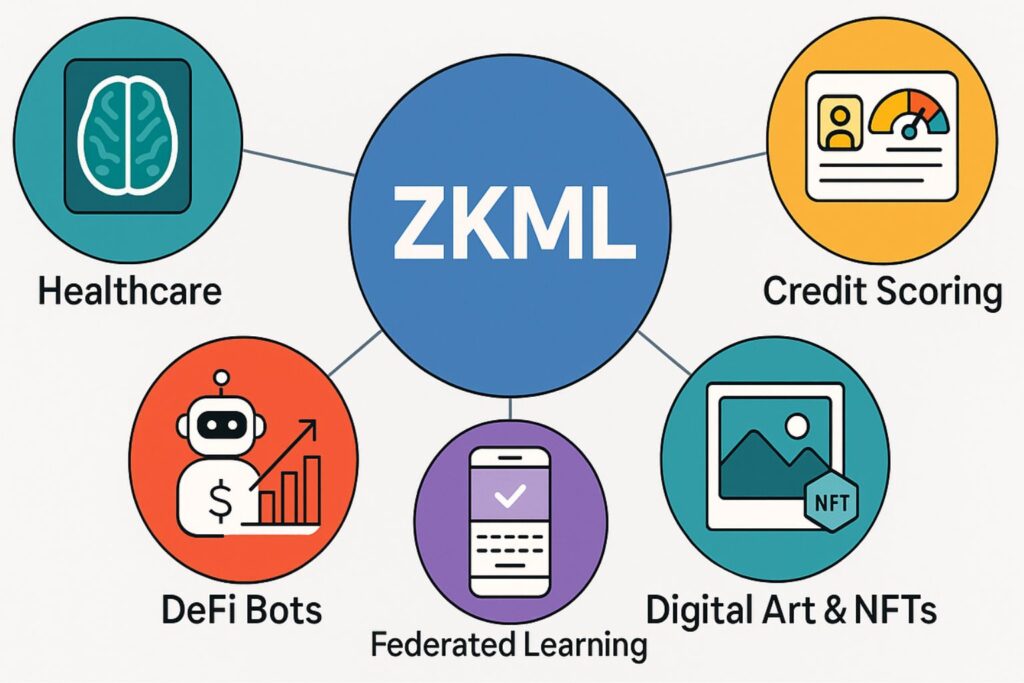
The efficiency gains provided by ZKML's optimizer directly impact the cost of verification. Lower proof generation costs enable more frequent and granular audits of AI models. This transparency is essential for institutions seeking to deploy AI in regulated environments where accountability is mandatory.
ZKML vs. Traditional Model Auditing
Traditional model auditing operates on a binary choice: trust the provider or inspect the code. Open-weight models offer transparency but sacrifice proprietary value and privacy, while black-box APIs provide convenience at the cost of verifiability. ZKML disrupts this trade-off by introducing cryptographic proof as the standard for trust.
In high-stakes financial applications, the inability to verify an AI model’s internal logic creates significant counterparty risk. Auditors cannot confirm that a model used specific data or adhered to regulatory constraints without access to the source code. ZKML resolves this by generating a zero-knowledge proof that attests to the model’s execution without revealing the underlying weights or input data.
The following comparison outlines the structural differences between these approaches regarding privacy, verifiability, and trust assumptions.
| Method | Privacy | Verifiability | Trust Assumption |
|---|---|---|---|
| ZKML | High (Proof only) | Cryptographic | Mathematical |
| Open-Weight | Low (Code exposed) | Manual Audit | Community Review |
| Black-Box API | High (Opaque) | None | Provider Reputation |
Key ZKML Protocols and Frameworks
The infrastructure for zero-knowledge machine learning is moving from theoretical papers to deployable code. Three distinct approaches currently dominate the landscape, each addressing the computational overhead of proving model execution with different trade-offs in speed and compatibility.
Worldcoin Framework
Worldcoin has released an open-source framework designed to construct proofs of ML model execution using ZK-SNARKs. Their approach focuses on a decentralized bounty platform for hosting and verifying models, aiming to standardize how proofs are generated and validated across different network participants. This framework is particularly relevant for developers looking to integrate verification into decentralized applications without building the underlying cryptographic engine from scratch.
Polyhedra Network
Polyhedra Network positions zkML as a critical evolution for AI trust, offering a suite of tools that allow anyone to verify that an AI model was executed correctly. Their commercial and open-source offerings emphasize ease of integration, providing APIs and SDKs that abstract the complex math of zero-knowledge proofs. This lowers the barrier to entry for enterprises that need to prove model integrity without exposing proprietary weights or input data.
DDKang’s ZKML
Developed by researcher Daniel Kang, this framework provides a high-level interface for constructing proofs of ML model execution. It is widely cited in academic and engineering circles for its rigorous approach to translating standard neural network operations into arithmetic circuits suitable for ZK-SNARKs. The accompanying paper and blog post offer detailed implementation insights, making it a preferred choice for researchers and engineers prioritizing mathematical correctness and proof efficiency over plug-and-play convenience.
Frequently asked questions about ZKML
How does ZKML verify AI inference?
ZKML verifies AI inference by converting the model's computational graph into an arithmetic circuit. The prover generates a cryptographic proof attesting that the circuit was executed correctly on specific inputs. The verifier checks this proof mathematically, confirming the output's validity without needing to re-run the inference or access the model's weights.
Why is ZKML important for financial compliance?
Financial institutions face strict regulations regarding algorithmic transparency and data privacy. ZKML allows banks to prove that their AI models adhere to regulatory constraints (such as fair lending laws) and use authorized data sources without exposing proprietary trading algorithms or sensitive client information to auditors or regulators.
What is the difference between ZKML and open-weight models?
Open-weight models provide transparency by publishing model weights, allowing anyone to inspect the code but sacrificing privacy and intellectual property protection. ZKML maintains privacy by keeping weights and inputs secret, while still providing verifiability through cryptographic proofs. It offers the auditability of open-weight models with the confidentiality of black-box APIs.
Is ZKML ready for production use?
ZKML is transitioning from research to production, with several frameworks now supporting real-world deployments. However, computational overhead remains a challenge. Optimizations in circuit design and hardware acceleration are improving proof generation speeds, making it increasingly viable for high-stakes applications where verification latency is acceptable.
No comments yet. Be the first to share your thoughts!