
What is ZKML and why it matters
Zero-Knowledge Machine Learning (ZKML) is the intersection of two distinct cryptographic and computational fields: zero-knowledge proofs (ZKPs) and machine learning inference. At its core, ZKML allows a prover to demonstrate that a specific AI model was executed correctly on a given input without revealing the model’s weights, the input data, or the intermediate computation steps.
Distinguishing ZKML from General ZKPs
General zero-knowledge proofs typically verify statements about arbitrary computations or financial transactions. ZKML specializes this capability for the unique constraints of neural networks. While a standard ZKP might prove "I know a password," ZKML proves "I ran ResNet-50 on this image and the output is class 'cat'" or "I executed one step of GPT-2 inference correctly."
The challenge lies in the mathematical nature of AI. Neural networks rely heavily on floating-point arithmetic, non-linear activation functions (like ReLU or Sigmoid), and matrix multiplications. Traditional ZKP circuits are optimized for integer arithmetic and boolean logic. ZKML bridges this gap by translating these continuous, complex operations into discrete, verifiable constraints that a zero-knowledge prover can handle efficiently.
The Core Value Proposition
The primary utility of ZKML is trust minimization in AI execution. Currently, when you interact with a cloud-based AI model, you must trust the provider that they ran the model exactly as advertised and did not tamper with the results. ZKML removes this trust assumption.
This matters for two critical reasons:
- Intellectual Property Protection: Model owners can allow users to query their proprietary models without exposing the weights. The user receives the output and a proof of correct execution, but never sees the underlying architecture or parameters.
- Data Privacy: Users can submit sensitive data to a model without the model owner ever seeing the raw input. The proof verifies that the computation was performed on the provided data without revealing what that data was.
In essence, ZKML transforms AI from a "black box" service into a verifiable computation, enabling secure, private, and trustworthy AI applications on decentralized networks.
How ZKML circuits verify model inference
Use this section to make the ZKML Explained decision easier to compare in real life, not just on paper. Start with the reader's actual constraint, then separate must-have requirements from details that are merely nice to have. A practical choice should survive normal use, maintenance, timing, and budget. If a recommendation only works in an ideal situation, call that out plainly and give the reader a fallback path.
The simplest way to use this section is to write down the must-have criteria first, then compare each option against those criteria before weighing nice-to-have features.
Implementing ZKML with EZKL and Polyhedra
Generating proofs for machine learning models is not a theoretical exercise; it is a concrete engineering workflow. The most practical path for developers today involves exporting a standard model, compiling it into a constraint system, and generating a proof that can be verified on-chain. This section walks through that exact pipeline using EZKL (a ZKML library) and Polyhedra Network, focusing on verifiable inference for models like ResNet or GPT-2.
The core challenge in ZKML is that neural networks rely on floating-point arithmetic, which is expensive to prove. To make this tractable, we quantize the model—converting high-precision weights to lower-bit integers—and then compile the model into an arithmetic circuit. This circuit defines the constraints that the zero-knowledge proof must satisfy. By using established tooling, you can automate this translation from PyTorch or ONNX to a ZK-compatible format.
Step 1: Export and Quantize the Model
Before generating any proofs, you must prepare the model for the constraint system. Neural networks are typically trained in floating-point (FP32), but proving FP32 operations is computationally prohibitive. Instead, you export your model (e.g., ResNet-18 or GPT-2) to ONNX format and then quantize it. Quantization reduces the precision of weights and activations, often to INT8 or even lower bit-widths, while maintaining acceptable accuracy. This step is critical because the complexity of the ZK proof scales with the number of constraints; lower precision means fewer constraints and faster proof generation.
Use PyTorch or TensorFlow to export your trained model to the ONNX format. This creates a platform-agnostic representation of your neural network's architecture and weights. Ensure the model is ready for inference with dummy inputs that match the expected shape (e.g., a batch of images for ResNet or a sequence of tokens for GPT-2). This ONNX file is the source material for the next step.

Convert the floating-point model into a quantized integer format. Tools like EZKL allow you to specify the bit-width (e.g., 8-bit integers) for weights and activations. This reduces the memory footprint and, more importantly, the number of arithmetic operations required during proof generation. The goal is to find the sweet spot where the model remains accurate enough for your use case while being efficient enough to prove within your budget and time constraints.
Use EZKL to compile the quantized ONNX model into a ZK-compatible circuit. EZKL translates the neural network layers into arithmetic constraints that a Zero-Knowledge Proof system (like Plonk or Marlin) can understand. This step generates the proving key and verification key. The proving key is used to generate proofs, while the verification key is embedded in your smart contract or verifier service. This compilation process is where the "machine learning" becomes "verifiable" by defining the exact mathematical rules the proof must follow.
Run inference on your model using your input data. During this process, the prover generates a cryptographic proof that the computation was performed correctly according to the compiled constraints. This proof attests that the output (e.g., an image classification or text completion) was derived from the specific model and input without revealing the model's internal weights or the input data itself. This proof is typically a compact binary blob that can be transmitted efficiently.
Deploy the verification key to your target environment. If you are building a decentralized application, you can verify the proof directly on a blockchain (like Ethereum or Polygon) using a pre-deployed verifier contract. For higher throughput, you might use an off-chain verifier service that checks the proof and then triggers an on-chain action. The verification step is fast and cheap compared to proof generation, making it suitable for real-time applications.
This workflow transforms AI from a "black box" into a verifiable component of your system. By following these steps, you ensure that the AI's output is not just a guess, but a cryptographically guaranteed result of a specific model. This is the foundation of trustless AI systems, where users can rely on the integrity of the computation without needing to trust the provider.
Decentralized AI and Edge Verification
ZKML transforms how we handle AI inference in environments where trust is scarce or computational resources are constrained. By treating the model execution as a verifiable computation, we can decouple the result of an AI model from the integrity of the hardware running it. This separation is critical for two emerging use cases: decentralized AI markets and private inference on edge devices.
Trustless AI Markets
In a decentralized AI marketplace, buyers need assurance that the model they are paying for is the exact one deployed by the seller. Without ZKML, this relies on blind trust in the provider. With ZKML, the provider generates a zero-knowledge proof attesting that the inference was computed using a specific model architecture (e.g., a ResNet-50 or GPT-2 variant) on the provided input.
This allows for a trustless exchange: the buyer verifies the proof cryptographically. If the proof holds, the output is guaranteed to come from the agreed-upon model, preventing model substitution or manipulation. This mechanism enables a marketplace where AI capabilities can be traded as commodities with cryptographic guarantees of authenticity and performance.
Private Inference on Edge Devices
Edge devices, such as smartphones or IoT sensors, often lack the power to generate full zero-knowledge proofs for complex models. However, ZKML enables a hybrid approach where the heavy lifting of proof generation can be offloaded or optimized. More importantly, it allows for private inference.
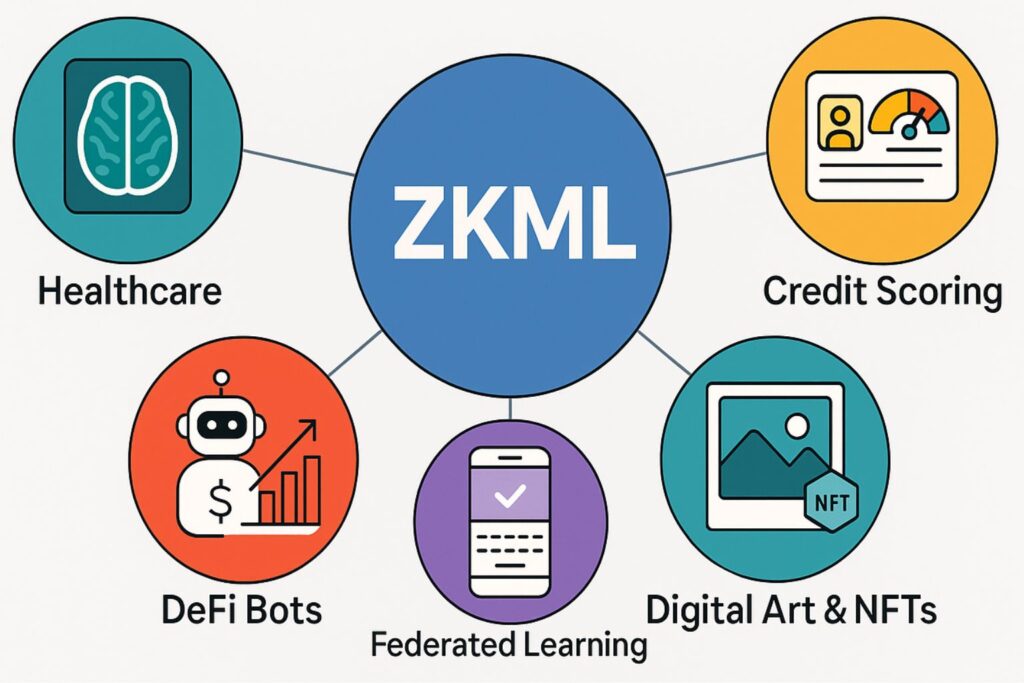
A user can send an encrypted query to a remote server. The server runs the AI model and generates a proof that the output is correct for that encrypted input, without ever seeing the plaintext data. This is essential for healthcare or financial applications running on decentralized networks, where data privacy is non-negotiable. The edge device receives the result and the proof, verifying that the remote computation was honest without exposing sensitive user data.
Blockchain-Based Auditing
For regulatory compliance and security, every inference can be anchored to a blockchain. The zero-knowledge proof serves as a succinct, on-chain record that a specific model was executed correctly at a specific time. This creates an immutable audit trail for AI decisions, which is increasingly required in regulated industries. It shifts the burden of trust from institutional reputation to mathematical verification, ensuring that AI systems remain accountable even in decentralized, permissionless environments.
Common zkml verification: what to check next
Zero-knowledge machine learning introduces specific engineering trade-offs between proof generation speed and computational overhead. These answers address the most frequent technical concerns regarding performance, model compatibility, and verification costs.
No comments yet. Be the first to share your thoughts!