
Why AI verifiability matters now
Artificial intelligence models operate as opaque black boxes. In high-stakes finance and healthcare, this lack of transparency creates significant liability. Regulators and institutions cannot audit decisions when the reasoning path is hidden inside proprietary weights. Trust based on provider reputation is no longer sufficient for compliance or risk management.
Zero-Knowledge Machine Learning (ZKML) addresses this opacity. By generating cryptographic proofs that a model executed correctly on specific data, ZKML shifts the paradigm from "trust the provider" to "verify the output." This allows institutions to confirm the integrity of an AI's decision without exposing the underlying model or sensitive input data.
The technical feasibility of this approach has matured. Recent frameworks, such as the system presented in ACM research (2024), demonstrate that ZK-SNARKs can now be generated for realistic, state-of-the-art models, including vision networks and large language models. This progress transforms ZKML from a theoretical concept into a deployable infrastructure layer for regulated industries.
How ZKML proofs work in practice
ZKML transforms opaque neural network decisions into auditable cryptographic evidence. The process does not reveal the underlying model weights or sensitive input data; instead, it generates a proof that the output was produced by a specific, verified computation. In high-stakes finance, this shift from blind trust to cryptographic verification is the primary mechanism for regulatory compliance and risk mitigation.
The workflow follows a strict sequence of translation, execution, and verification. Each step ensures that the mathematical integrity of the AI inference is preserved without exposing proprietary algorithms or private client information.
The first step involves translating the machine learning model into an arithmetic circuit. This circuit defines every operation—matrix multiplications, activations, and non-linear functions—as a set of mathematical constraints. Research frameworks, such as the ACM-published ZKML system, have demonstrated the feasibility of compiling state-of-the-art vision models and language models into these constraint systems, allowing standard neural networks to be represented in a format suitable for zero-knowledge proof generation.
With the circuit defined, the system executes the inference using the specific input data. The prover then generates a zero-knowledge proof (typically a zk-SNARK) that attests to the correct execution of the circuit. Early implementations relied on single, powerful machines to generate these proofs. However, as noted by industry analysts, the 2026 landscape is shifting toward parallelized proof generation across clusters to handle the computational intensity of large-scale models, reducing latency for real-time financial applications.
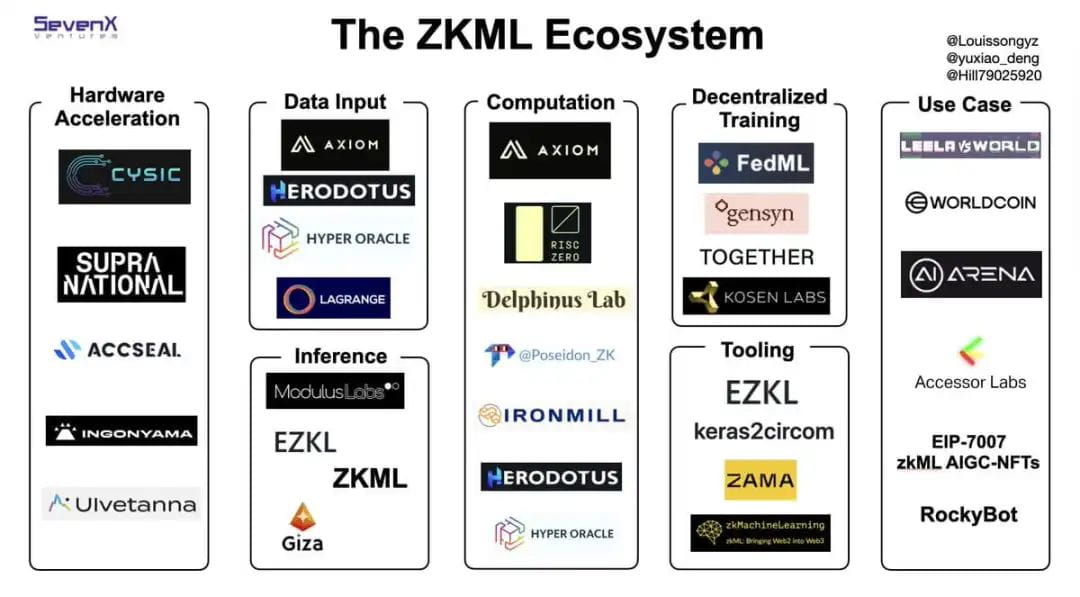
The final step is verification by the consumer or smart contract. Unlike traditional AI inference, which requires re-running the entire model to check for errors, ZKML verification is computationally cheap and fast. The verifier checks the cryptographic proof against the public parameters and the model’s public hash. If the proof is valid, the output is accepted as correct, ensuring that the AI decision was not tampered with and adheres to the approved model version.
The market is beginning to price in the utility of these verification layers. As regulatory scrutiny on AI increases, the ability to prove model integrity becomes a tangible asset.
Leading ZKML Platforms and Stacks
The infrastructure layer for zero-knowledge machine learning has fragmented into specialized stacks, each optimized for different computational constraints. In 2026, the distinction between general-purpose provers and domain-specific accelerators has become the primary metric for selection. High-stakes applications, particularly in regulated finance, require proof generation that is both verifiable and economically viable at scale.
Current implementations generally fall into two categories: monolithic provers running on single high-performance machines and distributed clusters that parallelize circuit execution. While the latter offers theoretical scalability, the former remains the standard for low-latency verification needs where network overhead introduces unacceptable risk. The table below compares the leading platforms based on their current technical maturity and supported model architectures.
| Platform | Primary Model Support | Proof Generation Speed | Production Maturity |
|---|---|---|---|
| Nexus | LLMs & Transformers | Medium (Cluster-optimized) | Beta |
| ZK-CV | Computer Vision (CNNs) | Fast (Hardware-accelerated) | Live |
| ProofBase | Tabular & Linear Models | Very Fast | Live |
| Mina ZK-ML | Lightweight Neural Nets | Medium | Alpha |
Selection criteria should prioritize the specific inference workload. Computer vision tasks benefit from hardware-accelerated circuits that reduce witness generation time, while large language models require distributed proving to manage the exponential growth of circuit constraints. Platforms like ProofBase dominate in structured data environments where linear algebra proofs are less computationally intensive. Conversely, general-purpose transformers remain challenging to prove efficiently without significant parallelization infrastructure, making them suitable primarily for high-budget, low-frequency verification scenarios.
Market outlook for ZKML tokens
The financial landscape for ZKML tokens remains defined by extreme volatility and speculative positioning rather than established utility. As a niche asset class intersecting zero-knowledge proofs and artificial intelligence, ZKML lacks the liquidity depth of major layer-one blockchains. Investors tracking this sector must distinguish between technical feasibility and market reality, recognizing that price movements are often driven by narrative cycles rather than fundamental adoption metrics.
Current market data reflects a cautious sentiment. While long-term projections from platforms like CoinCodex suggest potential growth to $0.039 by 2030, these figures rely on extrapolations of current low-volume trends rather than concrete revenue models. The token’s price action is heavily influenced by broader crypto market sentiment and specific announcements regarding ZK-proof integration in AI infrastructure. Investors should treat these projections as speculative scenarios, not guaranteed outcomes.
To monitor real-time valuation, the following widget provides live price data for the primary ZKML token. This data should be cross-referenced with on-chain volume metrics to assess genuine trading interest versus wash trading activity common in low-cap assets.
Common Pitfalls in ZKML Adoption
Adopting zero-knowledge machine learning requires navigating significant technical and economic barriers. The primary hurdle remains the cost of proof generation, which currently scales poorly with model complexity. For high-stakes financial decisions, this computational overhead can render real-time verification economically unviable without substantial infrastructure investment.
Current architectures often rely on single, beefy machines to generate proofs, creating a bottleneck. By 2026, the industry is shifting toward parallelized proof generation across clusters to mitigate latency. However, this transition introduces new complexities in circuit splitting and data synchronization that many early adopters underestimate.
Beyond infrastructure, the economic model for ZKML is still maturing. The "ZK-FHE Stack"—combining zero-knowledge proofs with fully homomorphic encryption—is emerging as the standard for sensitive cloud computations, but its implementation costs remain high. Organizations must weigh the premium of verifiable privacy against the marginal gains in trust, ensuring the technology fits their specific risk tolerance.
No comments yet. Be the first to share your thoughts!