
What ZKML actually does for AI
Zero-Knowledge Machine Learning (ZKML) bridges the gap between opaque AI models and the need for trust. It uses zero-knowledge proofs (ZKPs) to mathematically verify that an AI model ran correctly on specific data, without exposing the model weights or the input data to the verifier [src-serp-3]. This allows anyone to confirm an AI’s execution was honest, even if they cannot see the underlying code or the private information it processed [src-serp-6].
The core value proposition is verifiable inference. In traditional setups, trusting an AI means trusting the provider. ZKML shifts this dynamic by providing cryptographic proof of correctness. For example, if a healthcare provider runs a ResNet model on patient data, ZKML can prove the model processed the data accurately without revealing the patient’s identity or the proprietary architecture of ResNet itself.
This is distinct from general privacy tech like encryption or federated learning. Encryption protects data at rest or in transit but doesn’t prove computation integrity. Federated learning keeps data decentralized but doesn’t inherently verify that each node performed the calculation correctly. ZKML adds a layer of mathematical certainty: you don’t need to trust the AI; you can verify its output.
Why traditional AI verification fails
Enterprise AI systems operate as opaque black boxes. When a bank uses a model to deny a loan or a hospital relies on a diagnostic algorithm, the decision-making process is hidden inside layers of mathematical transformations. This lack of transparency creates a trust deficit that traditional monitoring tools simply cannot bridge.
Current verification methods rely on logging inputs and outputs. While useful for debugging, these logs do not prove that the model executed the correct logic. An auditor can see that a specific input produced a specific output, but they cannot verify that the internal weights and biases remained unchanged or that no adversarial manipulation occurred during inference.
This limitation is critical for intellectual property protection. When companies deploy models like ResNet or GPT-2 on external servers, they expose their proprietary architectures. Traditional auditing requires trusting the host infrastructure, which is impossible if the provider is malicious or compromised. You cannot verify the integrity of the computation without trusting the environment it runs in.
Data privacy presents an equal challenge. To audit a model’s behavior, organizations often need to inspect the training data or the internal states of the neural network. This requirement forces a trade-off: either expose sensitive customer information to gain trust, or remain blind to potential biases and errors. Neither option is viable for regulated industries.
Zero-Knowledge Machine Learning (ZKML) addresses this by allowing a model to prove its correctness without revealing its internal parameters. It shifts the verification burden from trusting the provider to mathematically proving the computation. This ensures that the AI behaves as expected, preserving both IP and privacy simultaneously.
How ZKML circuits verify inference
Translating machine learning inference into zero-knowledge proofs requires converting mathematical operations into arithmetic circuits. Unlike traditional verification, which checks code execution, ZK-SNARKs verify that a set of constraints was satisfied. This means every matrix multiplication and activation function in a model must be expressed as a system of polynomial equations.
The process begins by mapping the model’s layers to these constraints. For a linear transformation in a neural network, such as the core operation in ResNet or GPT-2, the system generates constraints that ensure the output vector equals the weight matrix multiplied by the input vector. The prover demonstrates knowledge of these values without revealing the weights or the input data itself.
Every layer in the neural network is decomposed into basic arithmetic gates (addition and multiplication). A linear layer, for example, becomes a set of constraints ensuring $y = Wx + b$. Complex operations like ReLU or softmax are broken down into piecewise linear approximations or lookup tables.
The size of the proof grows with the number of constraints. ZKML systems use optimizers to simulate circuit layouts and determine the most efficient arrangement. This reduces the "arithmetic complexity" by minimizing the number of gates required to represent the model.
Once the circuit is defined, the prover generates a succinct proof that the constraints were satisfied with specific private inputs. The verifier checks this proof against the public parameters of the circuit, confirming the inference was correct without needing to re-run the model.
The primary challenge in this workflow is arithmetic complexity. Large language models and deep vision networks contain millions of parameters, leading to an explosion in the number of constraints. If the circuit is too large, proof generation becomes prohibitively slow.
Optimization techniques are therefore critical. Systems like ZKML use cost models to simulate different circuit layouts, choosing configurations that minimize the total gate count. This allows state-of-the-art models, including distilled GPT-2 variants, to be verified within practical timeframes. Without these optimizations, the computational overhead would make zero-knowledge verification impractical for real-world AI applications.
Implementing ZKML with EZKL and Polyhedra
Generating a zero-knowledge proof for an AI model requires bridging two distinct worlds: the continuous mathematics of machine learning and the discrete logic of cryptographic circuits. You cannot simply plug a standard PyTorch model into a blockchain. Instead, the model must be translated into a form that a Zero-Knowledge Machine Learning (ZKML) prover can execute.
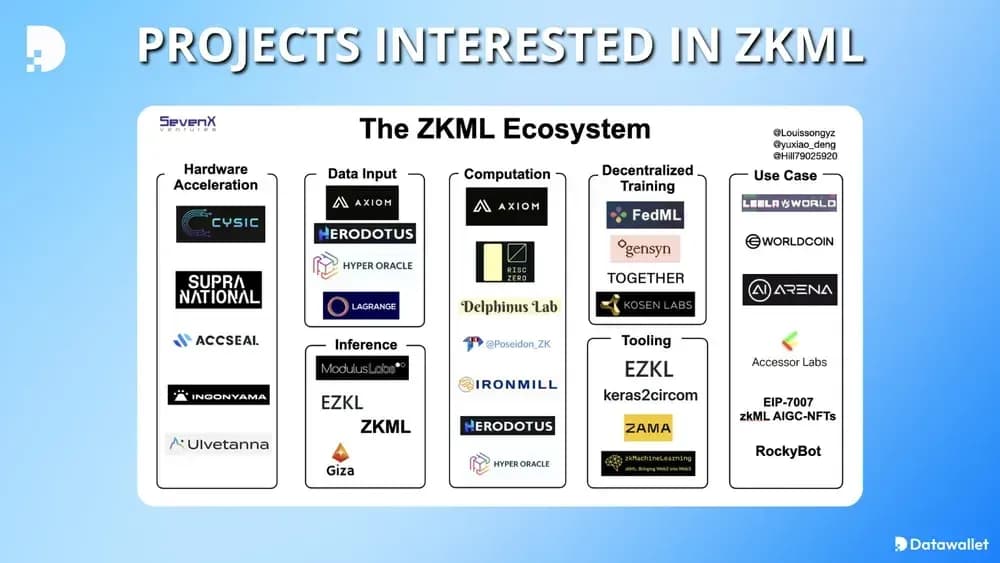
EZKL and Polyhedra Network simplify this translation. EZKL handles the heavy lifting of converting neural networks into arithmetic circuits, while Polyhedra provides the infrastructure to generate and verify these proofs efficiently. This combination allows engineers to focus on model accuracy rather than circuit design.
Most ZKML tools, including EZKL, require models to be in the Open Neural Network Exchange (ONNX) format. Export your trained model (e.g., a ResNet for image classification or a GPT-2 variant for text) from your framework (PyTorch or TensorFlow) into an .onnx file. This step ensures the model architecture is standardized and ready for circuit compilation.
Neural networks rely on floating-point arithmetic, but ZK circuits operate on finite fields. You must define the precision (e.g., fixed-point quantization) and the constraints for each layer. EZKL analyzes the ONNX graph to determine the optimal number of bits for weights and activations, balancing proof size against computational accuracy. This step is critical; too low precision degrades model utility, while too high precision makes proof generation prohibitively slow.

Run the EZKL CLI to compile the ONNX model into a circuit and generate a proof. The tool uses a backend like PLONK or Halo2 to create a cryptographic witness. For a model like ResNet-50, this process may take several minutes on a standard server. The output is a compact proof file and a verification key, which are much smaller than the original model weights.
Finally, submit the proof to a verifier. Polyhedra Network offers a zkML SDK that simplifies this integration, allowing you to verify the proof either on-chain (for maximum trustlessness) or off-chain (for speed and cost efficiency). The verifier checks that the output corresponds to the correct execution of the model on the given input, without revealing the input data or the model weights.
This workflow transforms AI inference into a verifiable commodity. By leveraging EZKL for circuit generation and Polyhedra for infrastructure, you can deploy AI models with cryptographic guarantees of correctness.
Enterprise use cases for verifiable AI
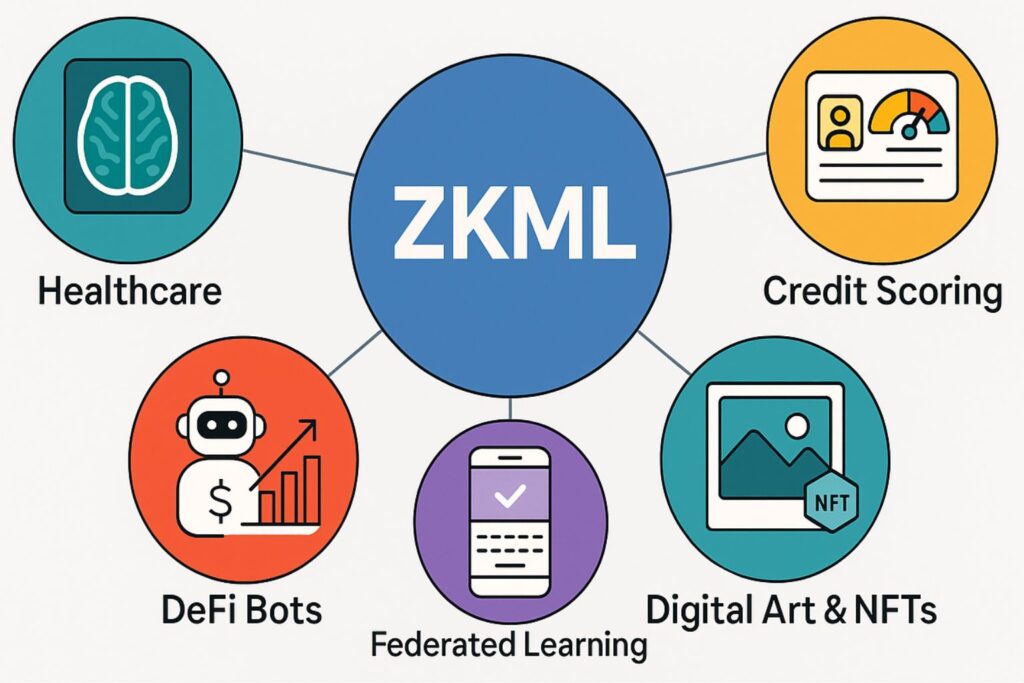
Zero-knowledge machine learning (ZKML) shifts verification from a trust-based assumption to a cryptographic guarantee. For enterprises, this capability is most valuable in three specific domains where data privacy, regulatory compliance, and intellectual property protection intersect.
Financial compliance and audit trails
Financial institutions face strict regulations regarding model explainability and data handling. ZKML allows banks to prove that a credit risk model was executed correctly on private client data without exposing the underlying dataset or the proprietary algorithm. This satisfies auditors who need assurance of integrity while keeping sensitive financial records confidential. The verification process generates a proof that the model’s output matches the input, creating an immutable audit trail for regulatory reviews.
Healthcare data privacy
Healthcare providers and research organizations often hold valuable datasets that cannot be shared due to HIPAA or GDPR restrictions. With ZKML, a hospital can verify that a diagnostic model, such as a ResNet variant trained on medical imaging, produced a correct prediction using patient data, without the model owner ever seeing the actual patient records. This enables collaborative AI development and third-party validation of diagnostic accuracy while maintaining strict patient privacy.
Decentralized AI marketplaces
In decentralized AI marketplaces, model creators need to protect their intellectual property while allowing users to verify inference results. ZKML enables a marketplace to prove that a specific AI model, such as a GPT-2 variant, was used to generate a response, without revealing the model weights or training data. This builds trust in the marketplace by ensuring that users receive the service they paid for, while protecting the creator’s proprietary algorithms from theft or reverse engineering.
-
Use ZKML when you need to prove model integrity without sharing IP, or verify inference on private data without exposing the data.
Common questions about ZKML
Zero-knowledge machine learning (ZKML) introduces new trade-offs between privacy, performance, and cost. Below are answers to the most frequent technical questions from engineers and CTOs evaluating these systems.
No comments yet. Be the first to share your thoughts!